


Photo credit: Photoholgic
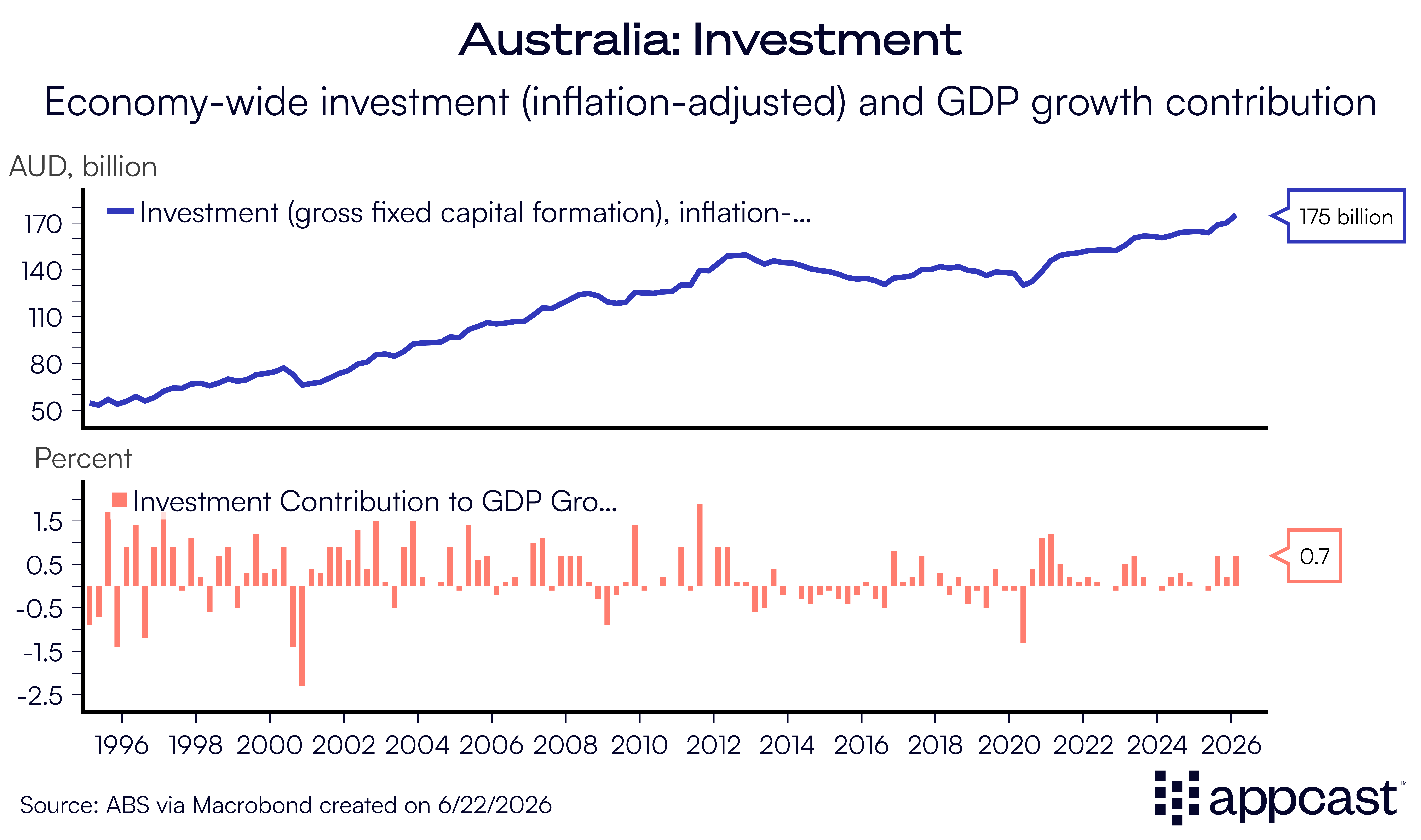
Australia has become one of the richest advanced economies in the world thanks to a combination of luck, good economic policies, and abundant resources. One big factor driving the growth story was China’s rapid economic development, which created a commodity supercycle during the 1990s and early 2000s. As a mining superpower, Australia benefited significantly from surging commodity prices at the time. Domestic investment — propelled by the local mining boom — was a key engine of the economic expansion between 1995 and 2012, contributing about 0.35 percentage points to an average quarterly growth rate of 0.83% (approximately 40%). But as the commodity supercycle ran its course after the Global Financial Crisis, so did the mining boom. Domestic investment fell in inflation-adjusted terms between 2012 and 2019. However, following the pandemic, capital expenditures have picked up significantly, once again contributing about 40% to GDP growth. This time, though, it’s not driven by mining but by AI. Like the U.S., Australia is abundant in land and cheap energy, making it well-placed to be at the forefront of the global data center boom.
The data center boom Down Under
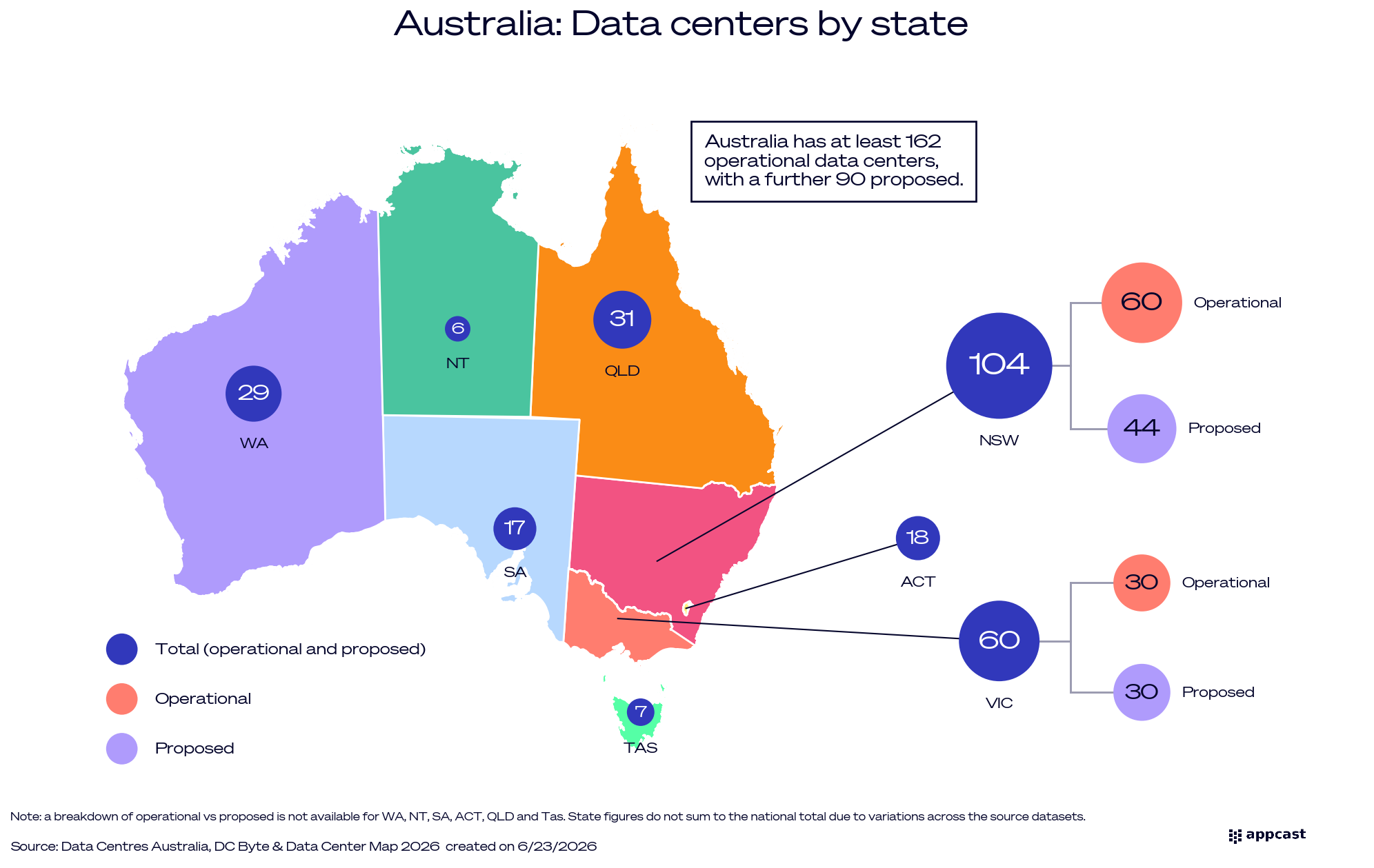
Research from the Climate Council shows to what extent Australia’s data center construction boom is ramping up, with most of the activity in New South Wales and Victoria. The two states share about 90 operational data centers between them, and another 74 in the pipeline.
Australia’s industry data indicates that the investment surge in the information and communications technology (ICT) sector is substantial. A completed data center incorporates both types of assets — structures and equipment. Relative to 2019, investment in buildings and structures in the ICT sector has roughly doubled, while capital expenditure in equipment has increased more than tenfold — these numbers are already adjusted for inflation.
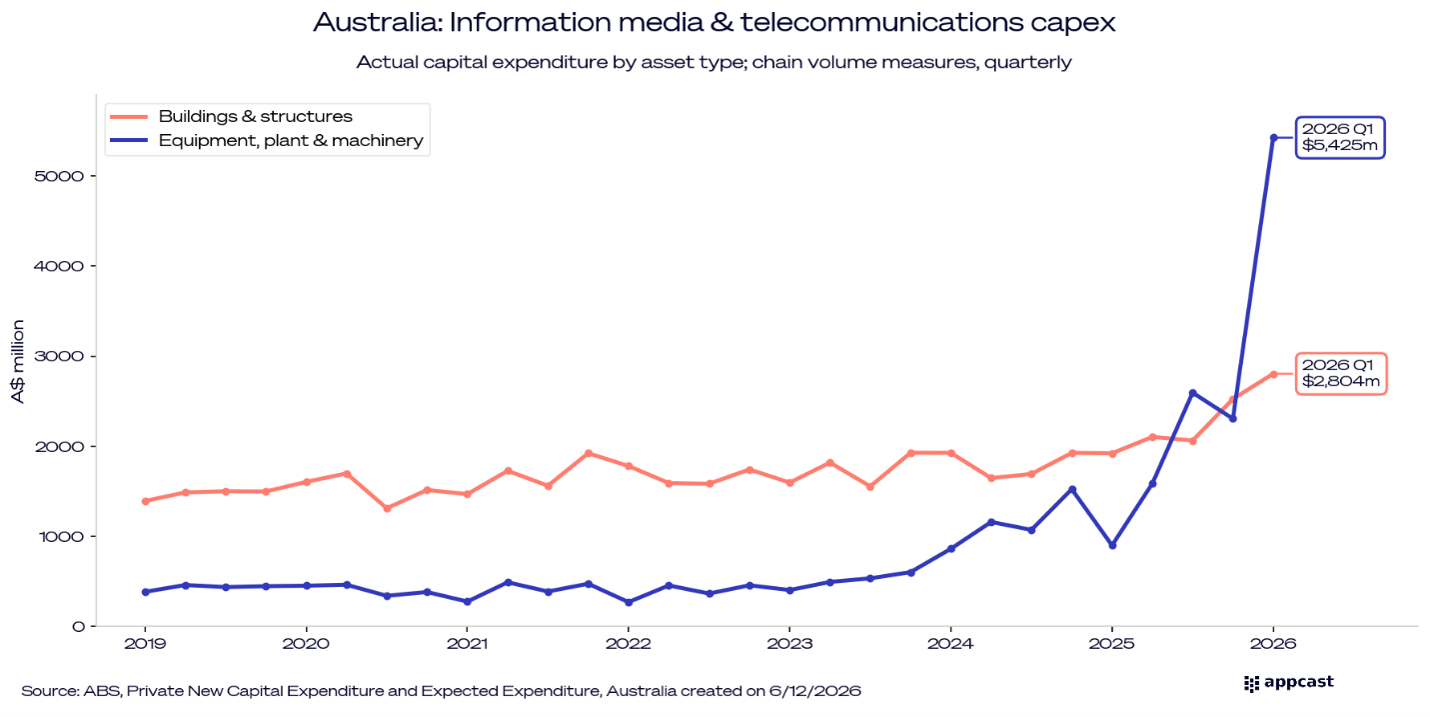
Taken together, this already represents more than 15% of economy-wide investment today. Westpac estimates that capital expenditures in data centers could exceed A$150 billion over the next decade, about 5.5% of annual GDP. If realized, this would equal and potentially even exceed the height of the mining boom. Much like the dot-com infrastructure rollout in the 1990s, this suggests that AI might truly be the next General Purpose Technology. Such a surge in capital spending will provide a meaningful boost to economic growth for many years, with positive knock-on effects for household incomes.
What is the implication for the labor market?
Is the data center boom already influencing today’s labor market, you might wonder?
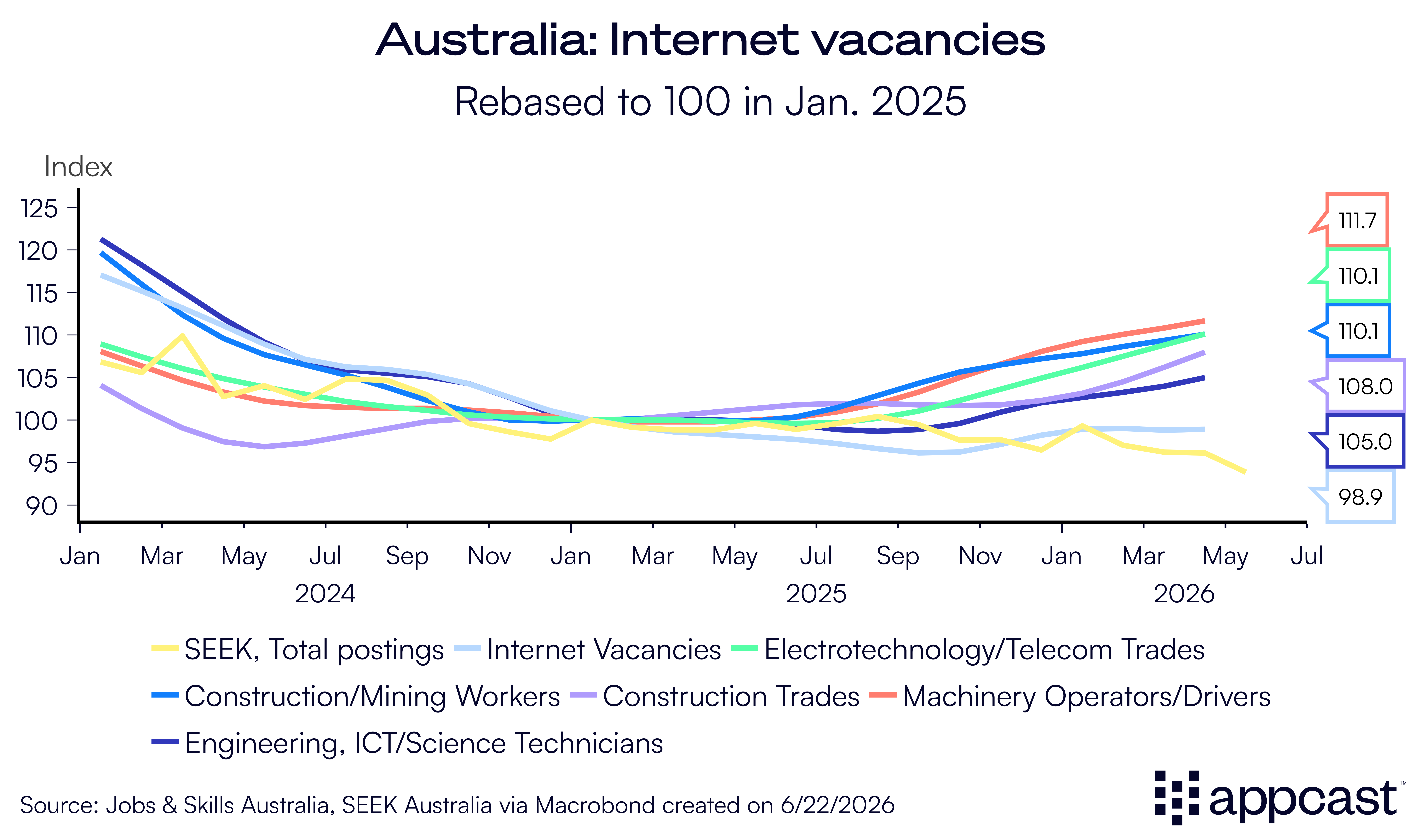
And the answer is yes! Even as Australia’s labor market remains significantly tighter than that of most other advanced economies, vacancies have fallen and the unemployment rate has increased from about 4% to 4.5% over the last two years. The internet vacancy index released by Jobs and Skills Australia — a government body — is down by a little more than 1% since January 2025. That is very similar to data from SEEK — Australia’s largest job board — which shows that total job postings are down by about 3.5% since then.
However, the decline in vacancies is not broad-based. While some white-collar occupations continue to trend downward, the story is very different for certain blue-collar jobs. In particular, the occupations that would benefit the most from increased construction spending on data centers and related infrastructure are showing a significant increase in hiring demand. Job postings for trades workers with the relevant skills have significantly outperformed the overall market: Electrotechnology and telecommunications trades are up by about 10%, and so are postings for construction trades and construction workers. Machinery operators and drivers are up by almost 12%.
SEEK created its own data center construction job ads index, which shows an even stronger rise than the select occupations highlighted above. Relative to 2019, job ads are up by more than 60%, with most of the surge happening since early 2025.
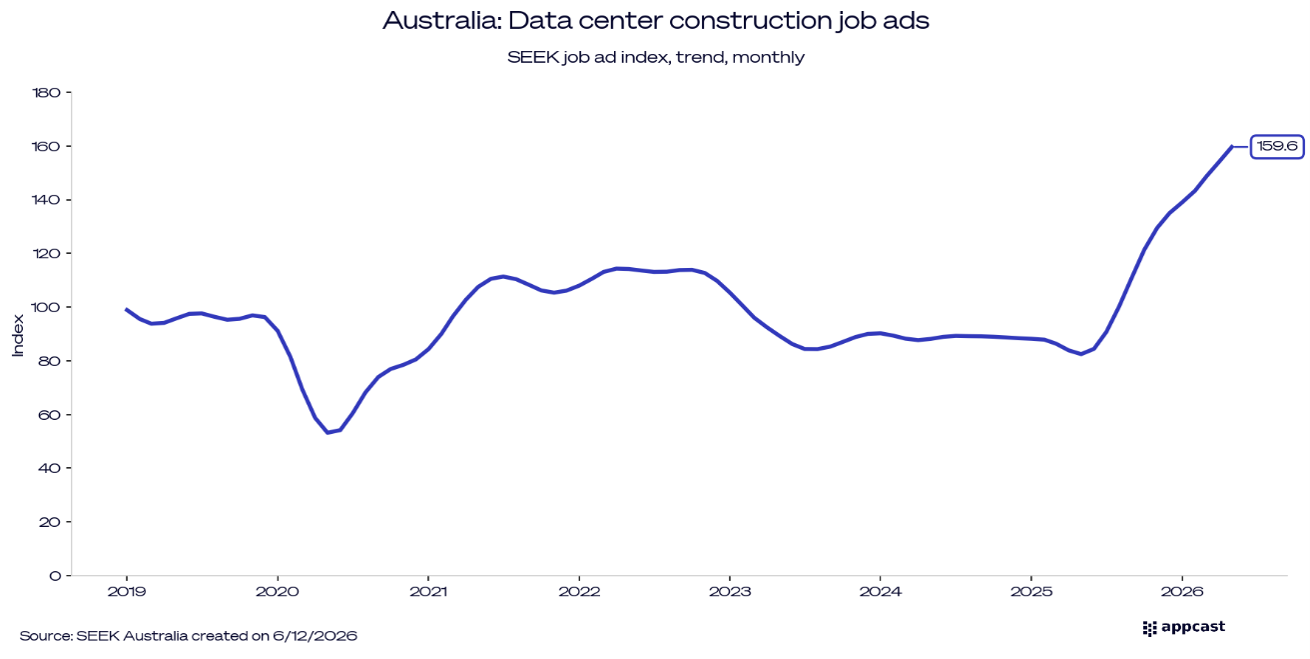
What is noteworthy is that postings for engineering, ICT, and science technicians are only up by 5%. For now, the AI boom is very much confined to infrastructure-related jobs, similar to what the U.S. economy is experiencing. Staffing needs for operational IT headcount — the people who actually operate and maintain the live facility once it’s switched on — come later and might be relatively small compared to the labor demand required for the current infrastructure boom.
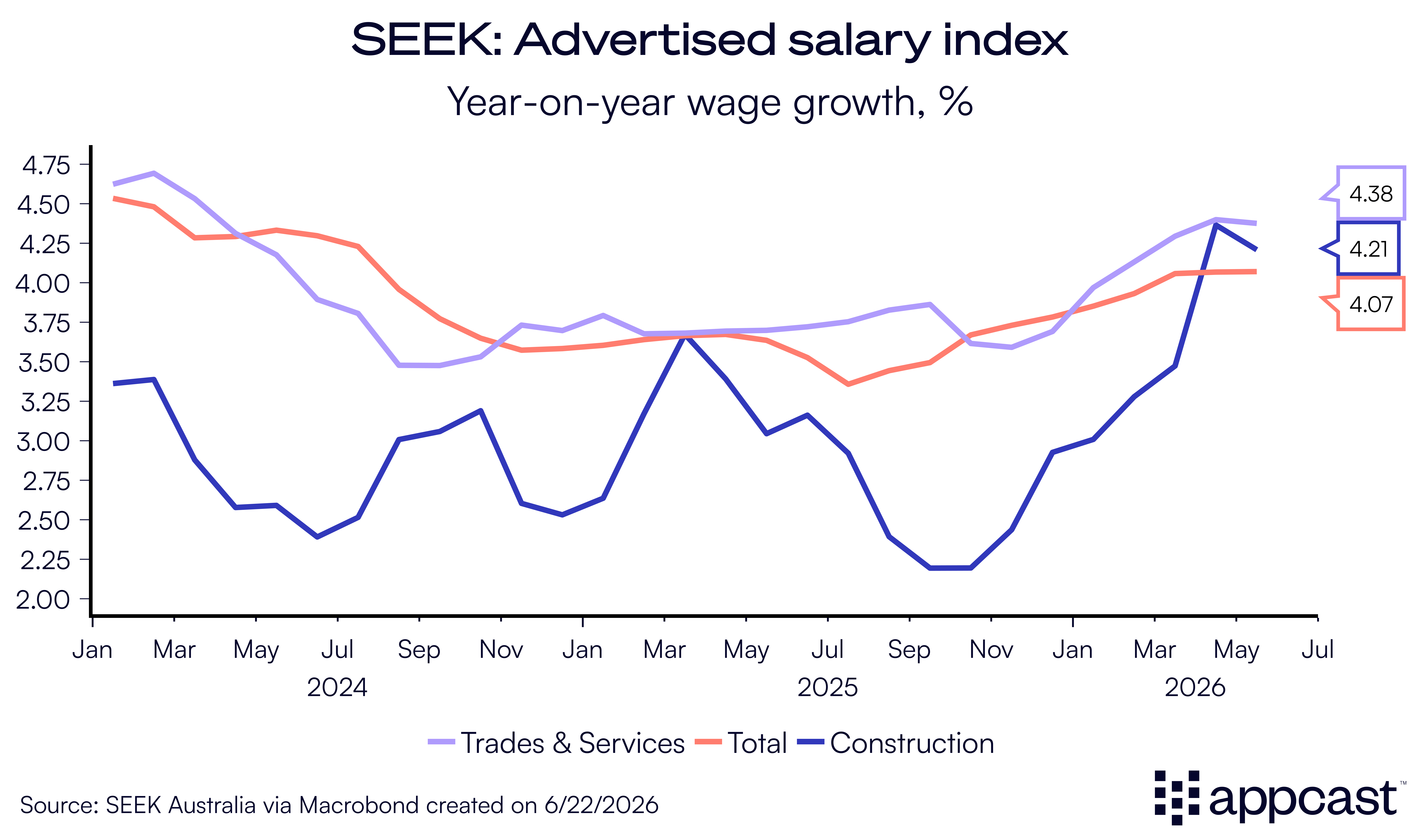
The divergence in hiring demand between blue-collar and white-collar occupations is also starting to have an impact on compensation trends. SEEK’s advertised salary data shows an acceleration in wage growth for trades workers and even more so for construction labor, both outperforming the overall market recently.
Is data center construction creating local labor market booms?
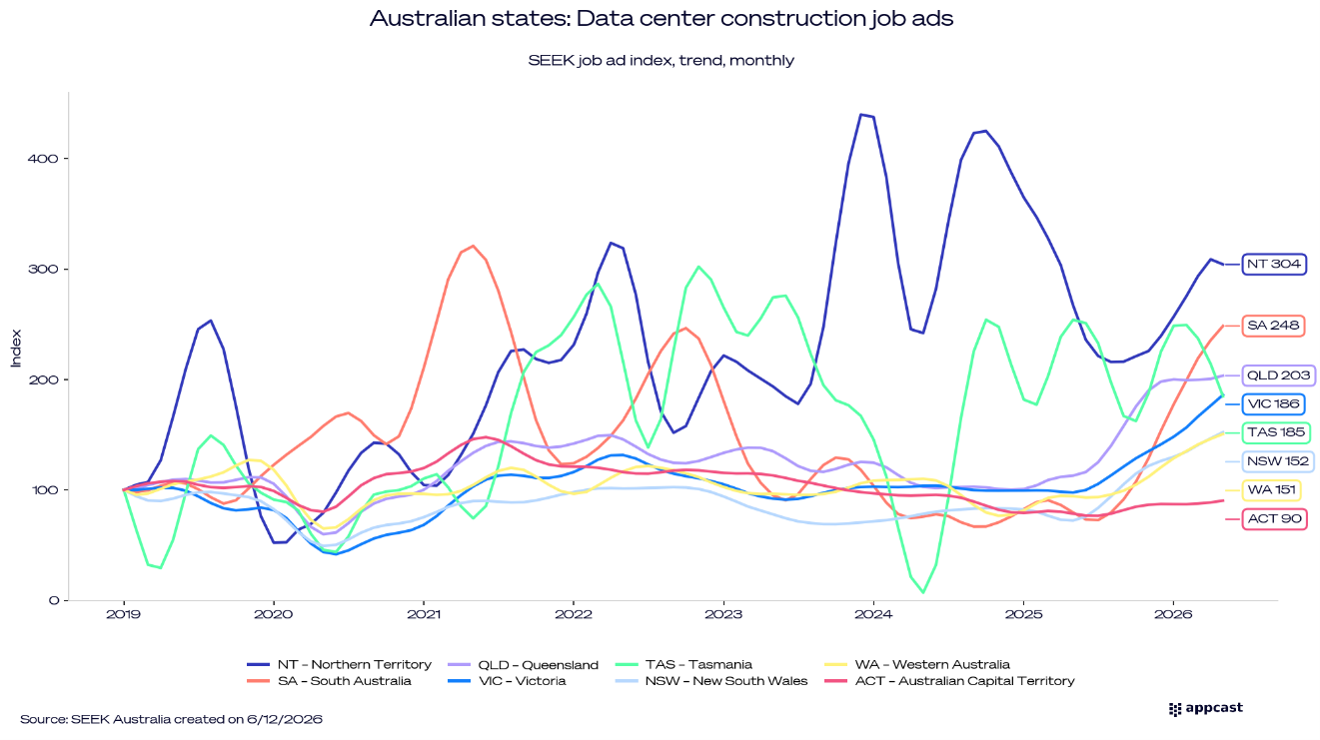
The significant surge in job ads related to data center construction is also creating regional hiring booms, especially in smaller labor markets. The chart below breaks down SEEK’s data center index by state. Two things are striking: First, the boom is happening nationwide with all states up quite significantly. Second, some smaller labor markets are displaying higher volatility, which makes sense. Total employment in the Northern Territory is about 145,000. The construction start (or completion) of one or several data centers can make a big difference to local hiring demand.
What does this mean for recruiters?
Like the U.S., Australia is well-placed to benefit from the global AI and data center boom thanks to its abundant land and cheap energy. The biggest constraint is the scarcity of skilled workers. Unlike other advanced economies, Australia’s labor market remains relatively tight. The country has historically relied on immigration to fill the gap. However, the global shift toward populism has also reached Australia. Even if the economy requires more workers, the political will for higher immigration might not necessarily exist. Meanwhile, the data center boom is putting additional pressure on the labor market. We are already seeing a surge in demand for various blue-collar roles — construction and specialized trades workers — benefiting from the spike in infrastructure spending. That pressure is also affecting compensation trends, with wage growth picking up for infrastructure-related occupations. Localized labor markets will remain extremely tight as long as the data center boom continues. For recruiters, this means that hiring for the roles highlighted above will remain a challenge, especially in local hot spots, and compensation demands will keep rising. For now, we don’t have any evidence that Australia’s data center boom is running out of steam any time soon.
Many thanks to Blair Chapman, chief economist at SEEK, for providing data for this piece.