



Photo credit: GR Stocks
There should be little doubt by now that AI will change our economies and labor markets in a fundamental way. The investment boom is already having a macroeconomic impact, with major U.S. tech companies plowing more than $1 trillion dollars into data centers. Labor markets are feeling the transformation as well, with the demand for workers shifting rapidly, and sometimes in unexpected ways. While the world economy will see stronger growth as AI is increasingly deployed, not everybody will benefit. Just like in previous technological cycles, the gains are spread unevenly. So you might wonder: who are the biggest winners and losers from AI? Don’t worry, keep reading — we’ll tell you!
1. Winners: Advanced economies
Economic theory suggests that poorer countries have the potential to grow faster and catch up with rich countries, provided they develop similar high-quality institutions and can rely on a skilled workforce. Eastern Europe is probably the best example of a previously underdeveloped region growing rapidly to join the club of high-income countries.
However, AI might throw a wrench into global convergence since the technology favors advanced economies. New research by the IMF shows that AI usage is highest in English-speaking high-income countries like the U.S. and the U.K., where adoption has spread much faster across sectors and occupations. The authors estimate that the total labor cost saved by AI usage (the “labor cost equivalent”) is approaching 3% of GDP in some high-income countries. This provides an indicative measure of the productivity gains that are feasible. The growth potential unleashed by AI is significant as workers become more productive across many different industries and professions, and not just a select few. The implication is that rich countries could start outgrowing poor ones in the years to come as AI adoption speeds up.
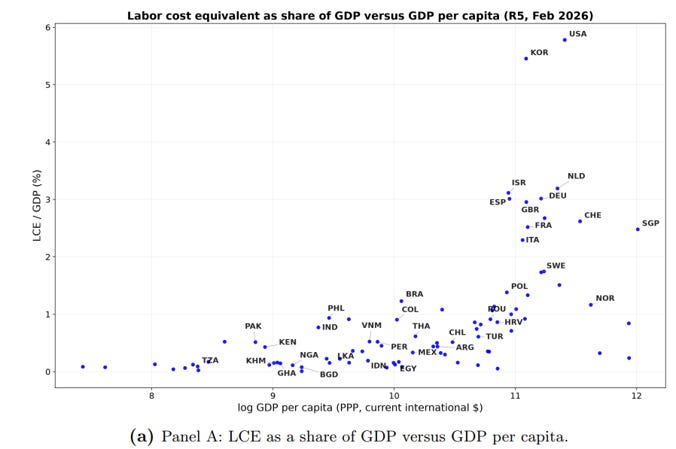
Source: Aggregate Gains from AI and Their Distribution: Global Evidence from Usage Data
2. Losers: Emerging markets
In emerging markets, AI adoption is narrow and tilted toward the very high-paid occupations, leaving most sectors and occupational spaces completely untouched. While top lawyers, software developers, and scientists might use AI frequently, the technology has not spread to the broader workforce. The low adoption is obviously concerning because it severely limits productivity gains. There is a considerable risk that poorer countries will underperform economically in the coming decade because they are bypassed by today’s technological supercycle.
3. Winners: Skilled AI workers
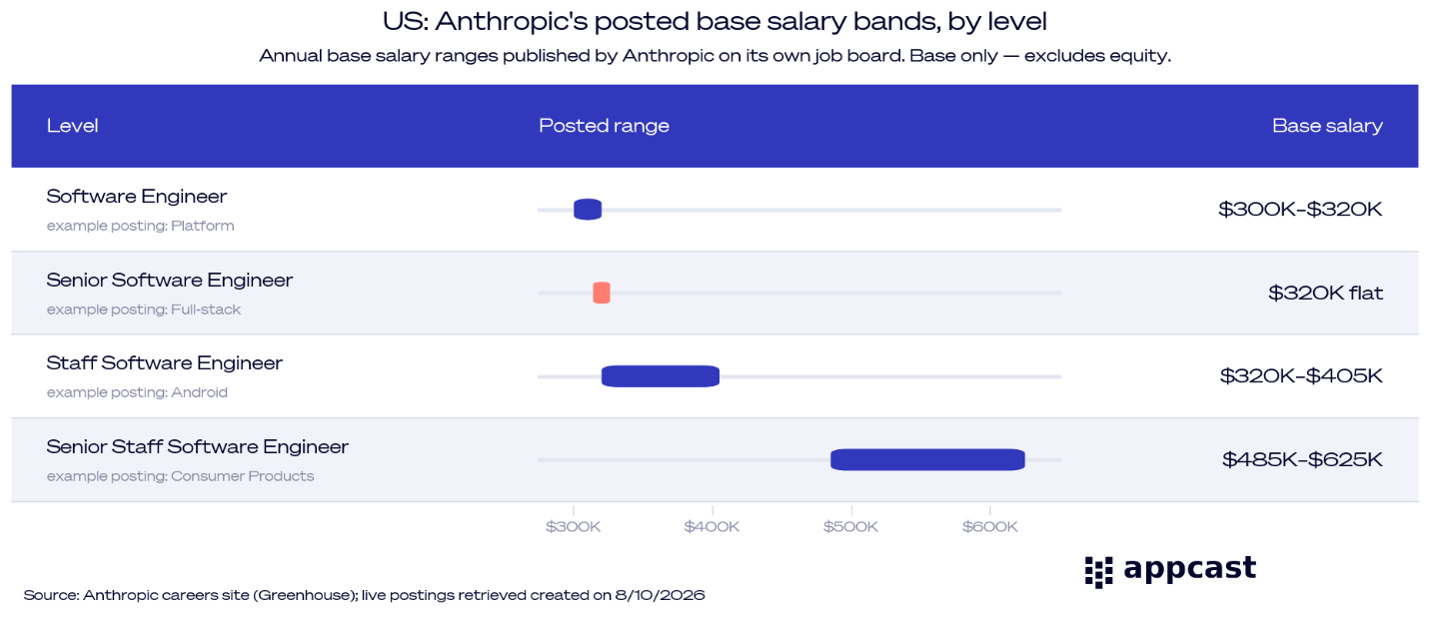
They are the obvious winners of today. As AI’s knowledge and output improve, so too does the productivity of workers who know how to harness it. These highly skilled workers are seeing their wages rise alongside this newfound productivity, with top earners reaching the upper six-figure range in the U.S. Anthropic is a great example of this. It offers software engineers an incredible base pay of $300,000. Compensation climbs with seniority, reaching $625,000 for senior staff software engineers — and that doesn’t even include the equity shares Anthropic offers on top. The productivity boost from AI will without a doubt widen the divide between these skilled knowledge workers and our next biggest loser, routine white-collar workers.
4. Losers: Routine white-collar professions
The fear that “AI will take over all jobs” is largely overstated; however, AI is contributing to slower hiring for routine white-collar desk jobs. We are already seeing this happen in large consulting firms, financial companies, and tech. Many big companies have significantly reduced job postings and are projecting lower headcount in the years ahead as they seek to improve efficiency through automation with AI. The roles that are made redundant include HR professionals, project managers, marketing roles, customer service, and administrative assistance. Especially for the latter two occupations, AI has shown great promise in automating many of the tasks.
5. Winners: Data center construction jobs
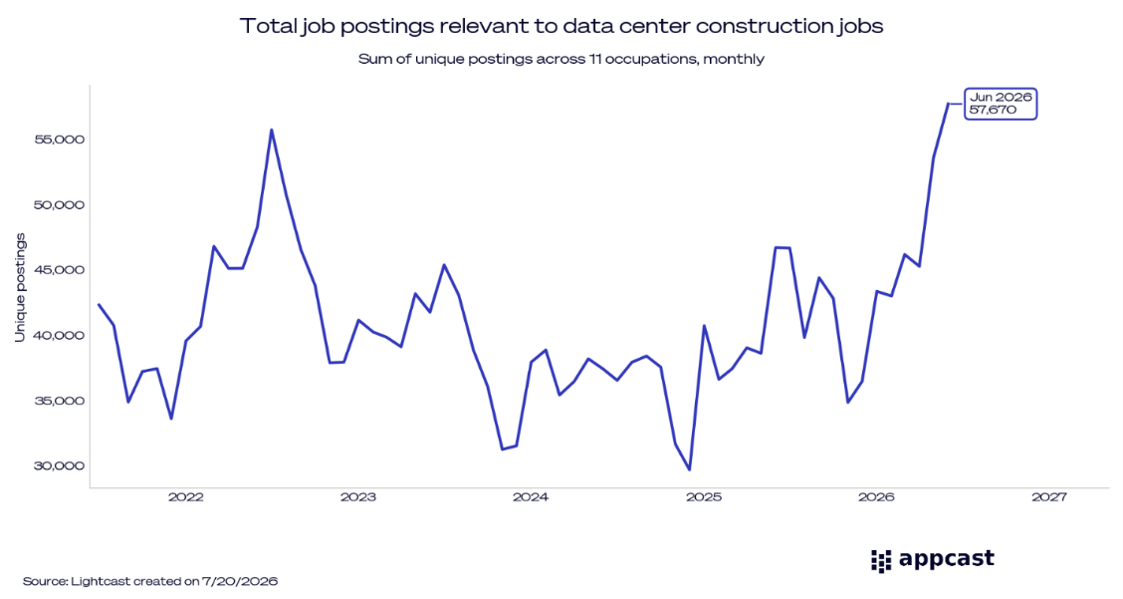
Blue-collar workers, on the other hand, stand to gain from the boom. Data center construction is increasing exponentially across the U.S., and with it the need for jobs required to build out the infrastructure. Electricians, plumbers, pipefitters, and HVAC technicians are benefiting from surging orders and the rising pay that follows. Job postings for these roles are climbing. This is especially the case in remote areas where the AI infrastructure is being built, while skilled workers are in short supply.
6. Losers: Companies competing with the AI boom
With the rapid expansion of data center construction, demand is rising for the skilled trades needed to build and maintain these facilities. This surge in demand is putting additional pressure on employers already competing for a limited pool of qualified workers, intensifying the hiring squeeze and pushing wages higher. Walmart is a good example of this. Maintaining its stores and logistics centers relies on the same workers needed for the data center buildout: HVAC technicians and commercial electricians. And what’s true for Walmart also applies to many other businesses with less financial firepower that are caught in a talent war with the companies involved in the AI boom.
7. Winners: Experienced professionals
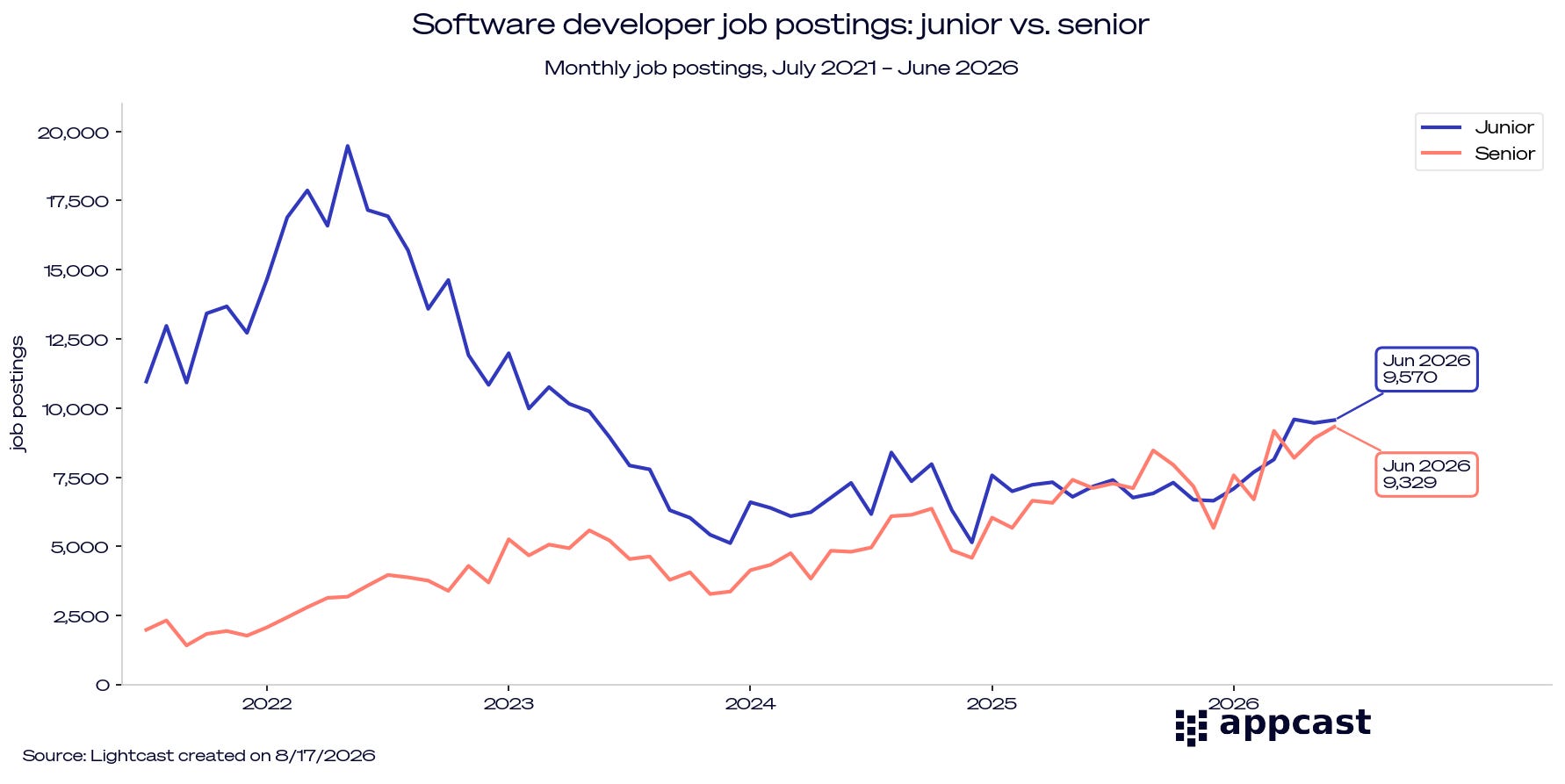
Anthropic’s career page reveals a substantial jump in compensation as workers reach senior-level positions. Looking at job postings, we can see that this divide extends beyond salary. Job ads for senior-level roles have almost doubled since 2023. Meanwhile, demand for junior-level hiring has fallen well below its post-pandemic peak, although recent data suggests a modest recovery. As technology becomes more deeply integrated into large companies, employers are increasingly favoring the skills and experience of senior workers, which seem complementary to AI.
8. Losers: Graduates
Graduates are facing one of the worst job markets in many years. The rising adoption of AI, combined with the persistence of remote and hybrid work since the pandemic, makes it increasingly difficult for young workers to enter highly AI-exposed occupations. Working from home increases the cost of hiring inexperienced employees because training, supervision, and mentorship are harder to achieve in a remote setting. Meanwhile, many employers are using AI to automate tasks that young workers have previously done. As these two factors work together, it is impossible to ignore the conclusion that recent graduates and entry-level workers are getting the short end of the stick.
9. Winners: Soft skills — the human premium
As AI is implemented into day-to-day work at large companies, those with strong soft skills, such as leadership, communication, and public speaking, will begin to stand out. It is no secret that AI can create nearly seamless presentations and analyze incredible amounts of data quickly. However, it still cannot communicate ideas to a team or crowd as effectively as a human can. A monotone video created by AI will never be as compelling as a truly witty and charismatic speaker addressing clients in person. Along the same lines, quality leadership of a team or corporation will not be replaced by an AI agent anytime soon. As AI improves, the human element becomes more important again. Students are already adapting to the change. Enrollment in computing degrees has fallen significantly, while social science degrees are becoming more popular.
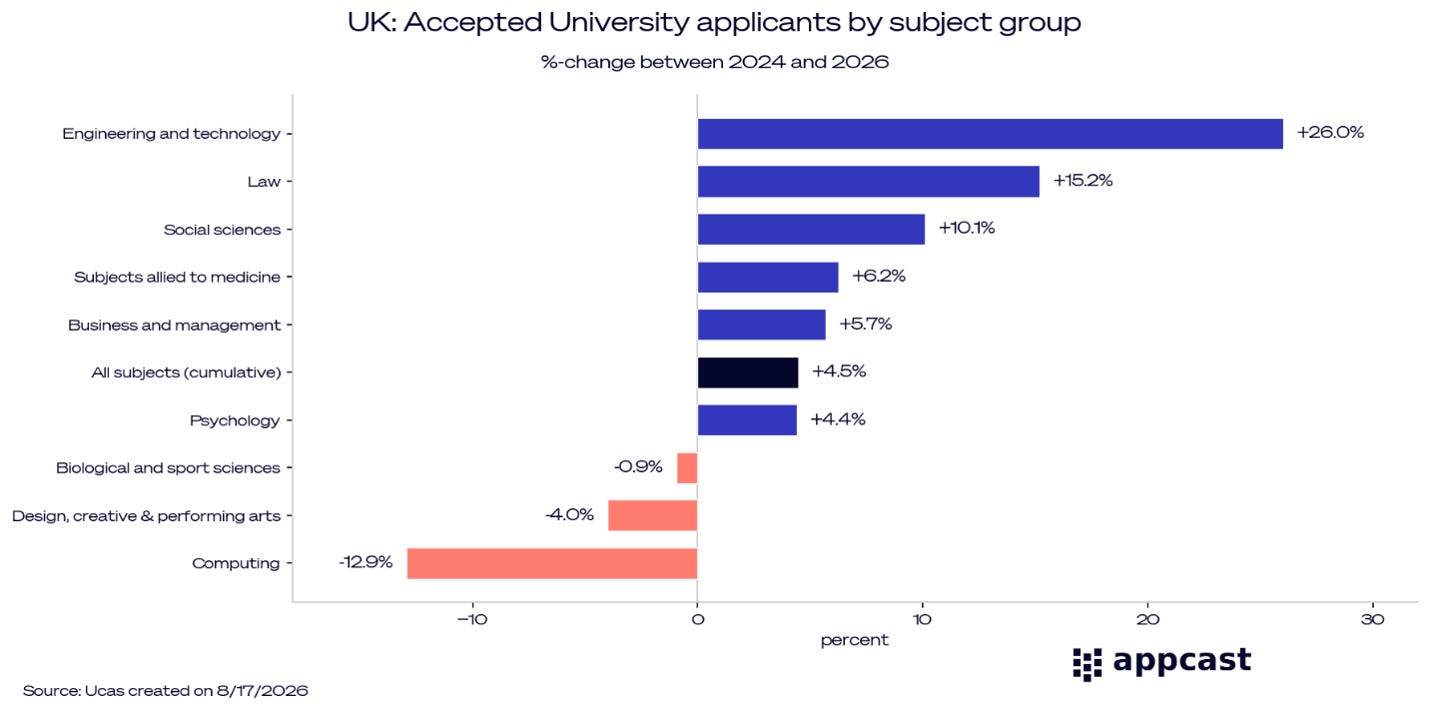
10. Losers: Hard technical skills like coding or math
Claude and other large language models (LLMs) can code much faster and cleaner than humans can. Degrees like computer science and math become less valuable as LLMs prove theorems that have eluded mathematicians for decades. It is still helpful to possess the knowledge and skills that these degrees come with, but their value is declining in relative terms.
What does this mean for recruiters?
Like any General Purpose Technology, AI creates both winners and losers. When the steam engine was created, factory owners were among the biggest beneficiaries, while artisans faced increasing competition and displacement. When electricity became widespread, most businesses and households benefited enormously, but lamplighters were displaced. Innovation comes with a cost but can also be incredibly rewarding. Although the disruption caused by the AI boom may be divisive, technological change at such scale has historically boosted growth and lifted living standards. The challenge for workers is to adapt quickly enough to benefit from it. For recruiters, the trends highlighted above suggest that the fiercest competition will be for the trades, senior talent, and people-facing skills — while demand for routine white-collar roles and junior positions keeps softening.