


Photo credit: Christopher Bill
For many years, economists have debated fiercely why the U.K.’s productivity numbers following the Global Financial Crisis were so abysmal. Not only was GDP per hour growing much slower than before, but growth also fell well below that of other advanced economies, making the U.K. an international outlier. Some suggested that the U.K.’s housing bubble and overreliance on the financial sector left a permanent scar when the crisis hit in 2008-09. Others argued that austerity and insufficient public infrastructure investment were to blame. Yet another strand of thought blamed the country’s weak performance on London’s economic dominance, strangling growth elsewhere. But it turns out that no explanation was needed after all. A recently improved methodology actually shows the U.K. outperforming most other advanced economies and matching the U.S. It wasn’t bad performance, simply bad data! In this piece, we will explain what this means and why the U.K.’s newfound productivity gains are not all good news.
UK productivity is much higher than previously thought
New data released by the Office for National Statistics (ONS) shows that U.K. productivity has grown significantly faster: Instead of growing by about 34% since 1997, productivity has actually grown by 47%, a sizable difference. More importantly, most of the gap is due to mismeasurement since the Global Financial Crisis.
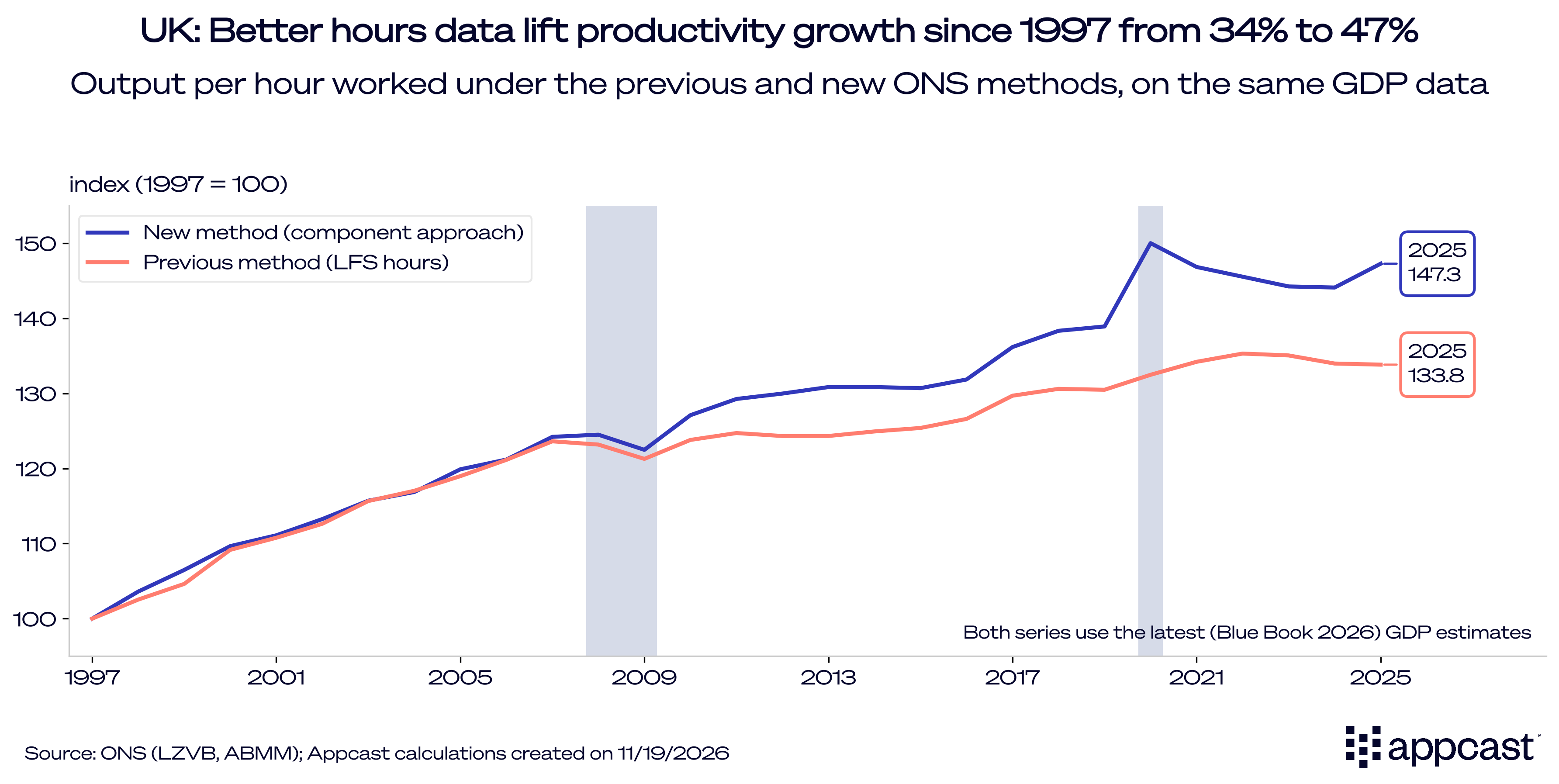
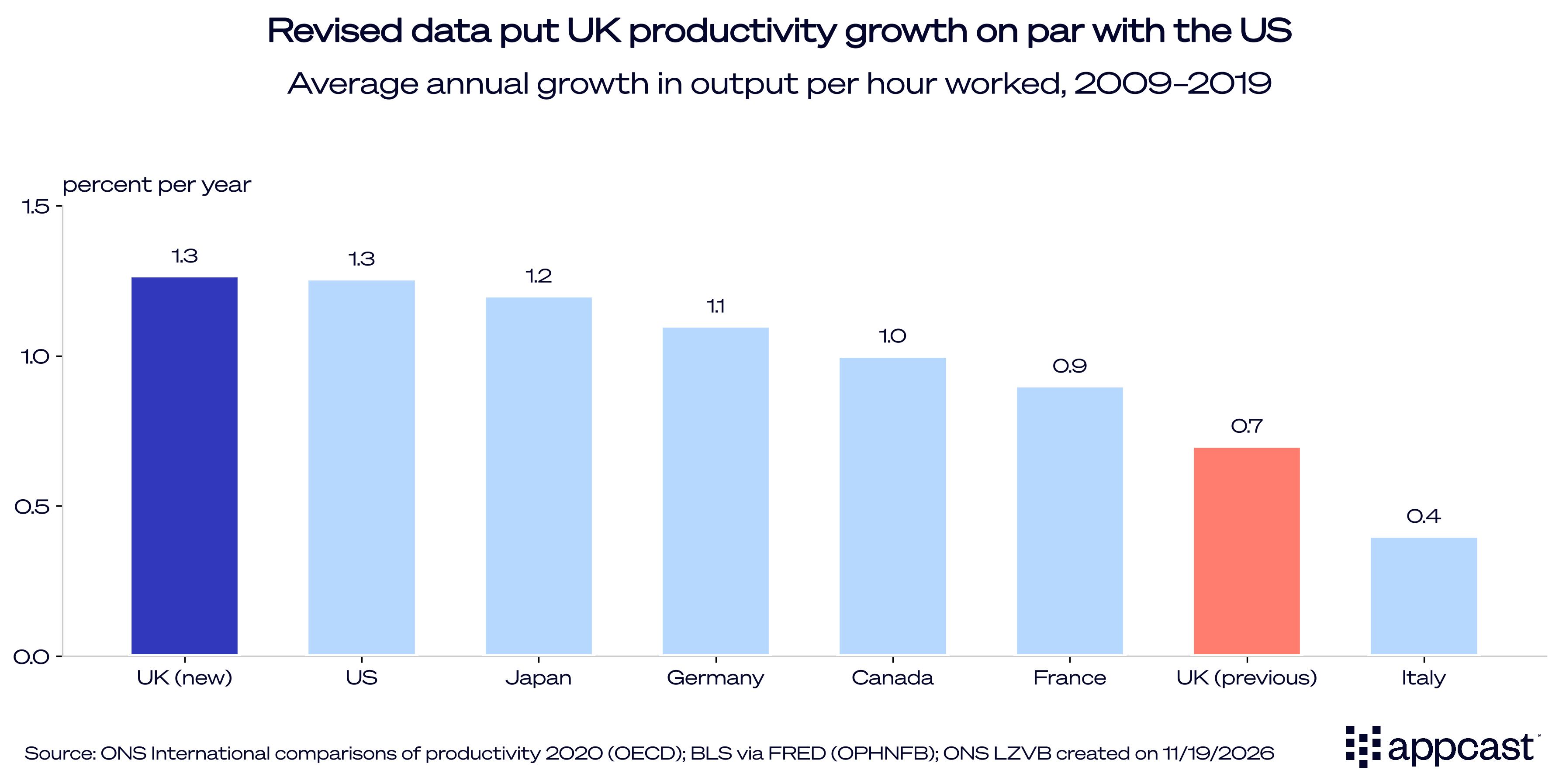
With the new estimates, the U.K.’s “productivity puzzle” economists had discussed for years has essentially been solved. The revised data shows that between 2009 and 2019 productivity — how much GDP the average British worker produces per hour — grew by about 1.3% annually instead of 0.7%, almost twice as much. In the blink of an eye, data revisions catapulted the U.K. from one of the slowest to one of the fastest performers in productivity growth among large, advanced economies, on par with the U.S.
Why the data was inaccurate and what changed
You might now wonder why the data was so incredibly inaccurate. And that’s a fair question. While GDP figures often get revised years later, the changes are usually relatively small, definitely not as large as the revision to the U.K. productivity numbers. Those were mismeasured because the ONS vastly overestimated working hours. Historically, the ONS has relied on the Labour Force Survey — basically asking workers how many hours they typically put in. As it turns out, that data is not very accurate. It’s also not how other statistical agencies measure it. Instead, they count the total number of jobs in the economy using employer data, multiply that by average paid hours, subtract the time that was paid but not worked (leave, sickness, bank holidays), and add overtime.
Using this revised method, the ONS finds that average actual hours worked per job in the third quarter of 2026 were about 12% below their 1997 average. Falling usual working hours account for roughly 6 percentage points of that decline. Parental leave, less unpaid overtime, and other reasons shave off another 2 percentage points, and annual leave and bank holidays about 1 percentage point. About 4 percentage points reflect a shift in the mix of jobs toward industries with shorter average hours (workers moving from manufacturing to retail, for example). Lower sickness absence pushes the other way, adding back just under 1 percentage point.
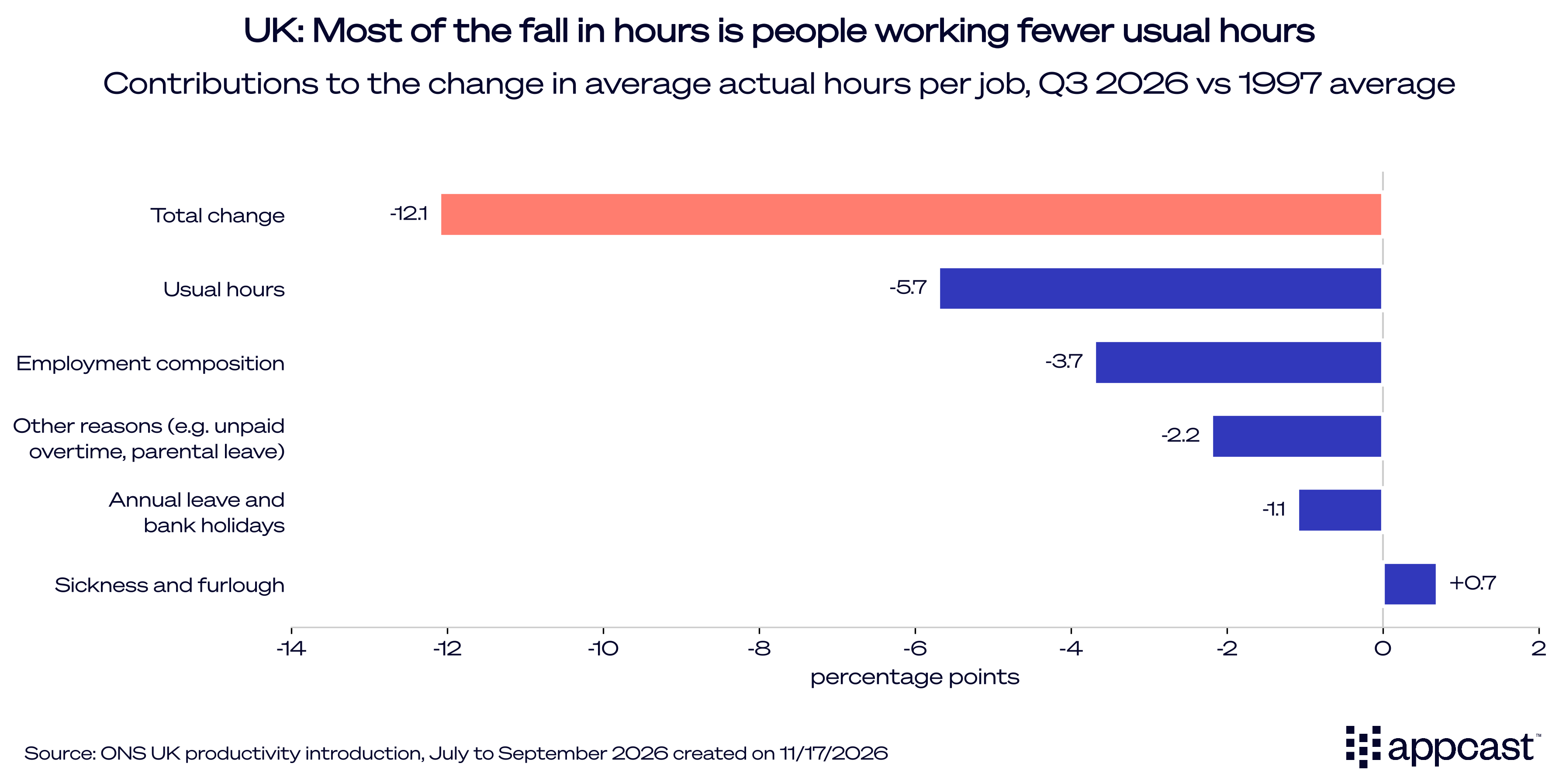
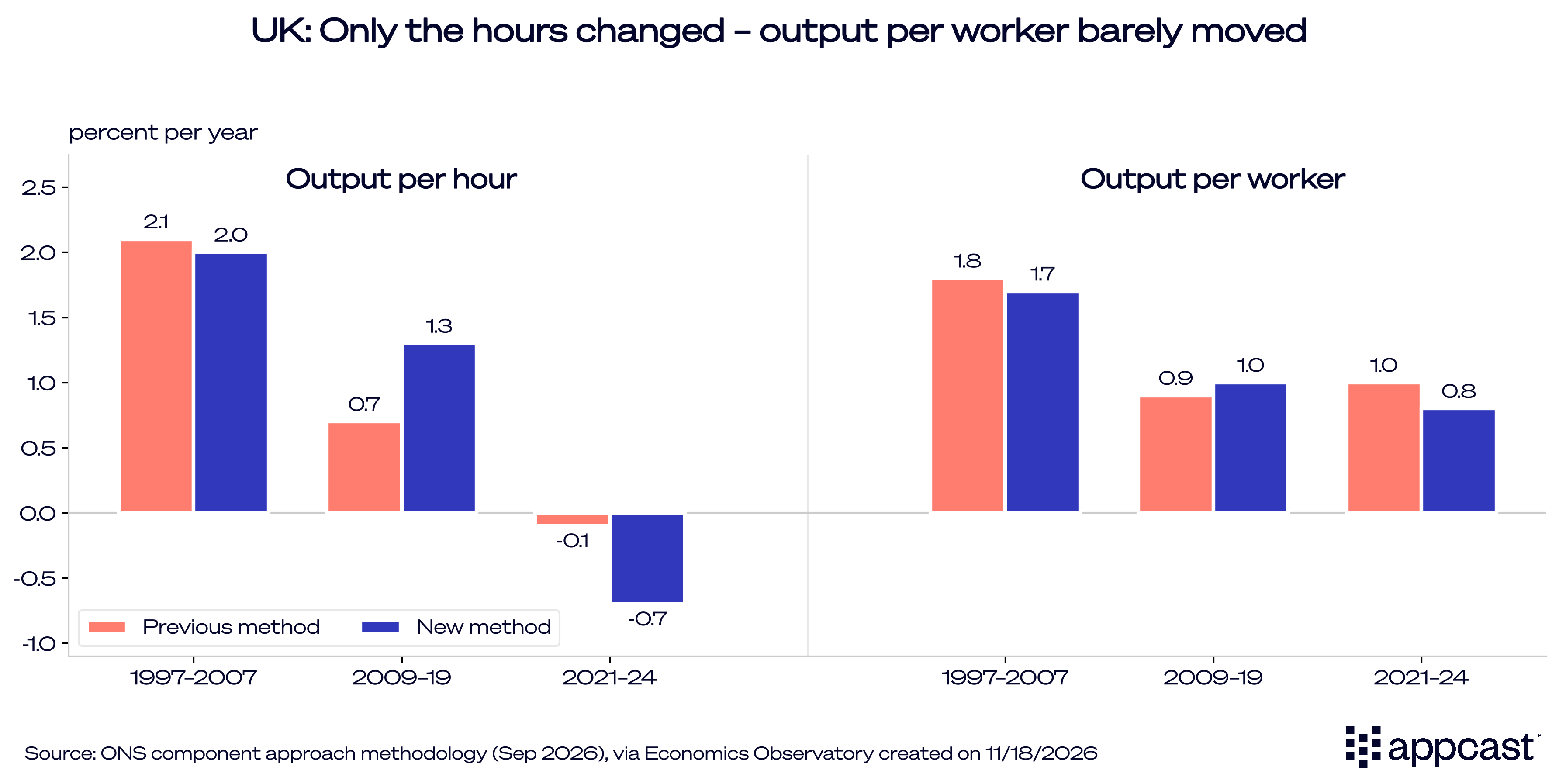
In other words, British workers have been working way less than previously believed! Because the revision only affects hours, GDP estimates remain largely unchanged. The significant decline in working hours affects only productivity: The average British worker is producing more output per hour, but not more output in total. Incomes and purchasing power, therefore, remain unchanged.
Working less — it’s not always a choice
The big question is whether the reduction in working hours was a deliberate choice or whether it’s something that was forced upon workers. It’s not a problem if people want to work less or go only for part-time roles. However, if economic factors such as the design of the tax system force a reduction in hours worked, it comes at the expense of both households’ financial well-being and economic growth.
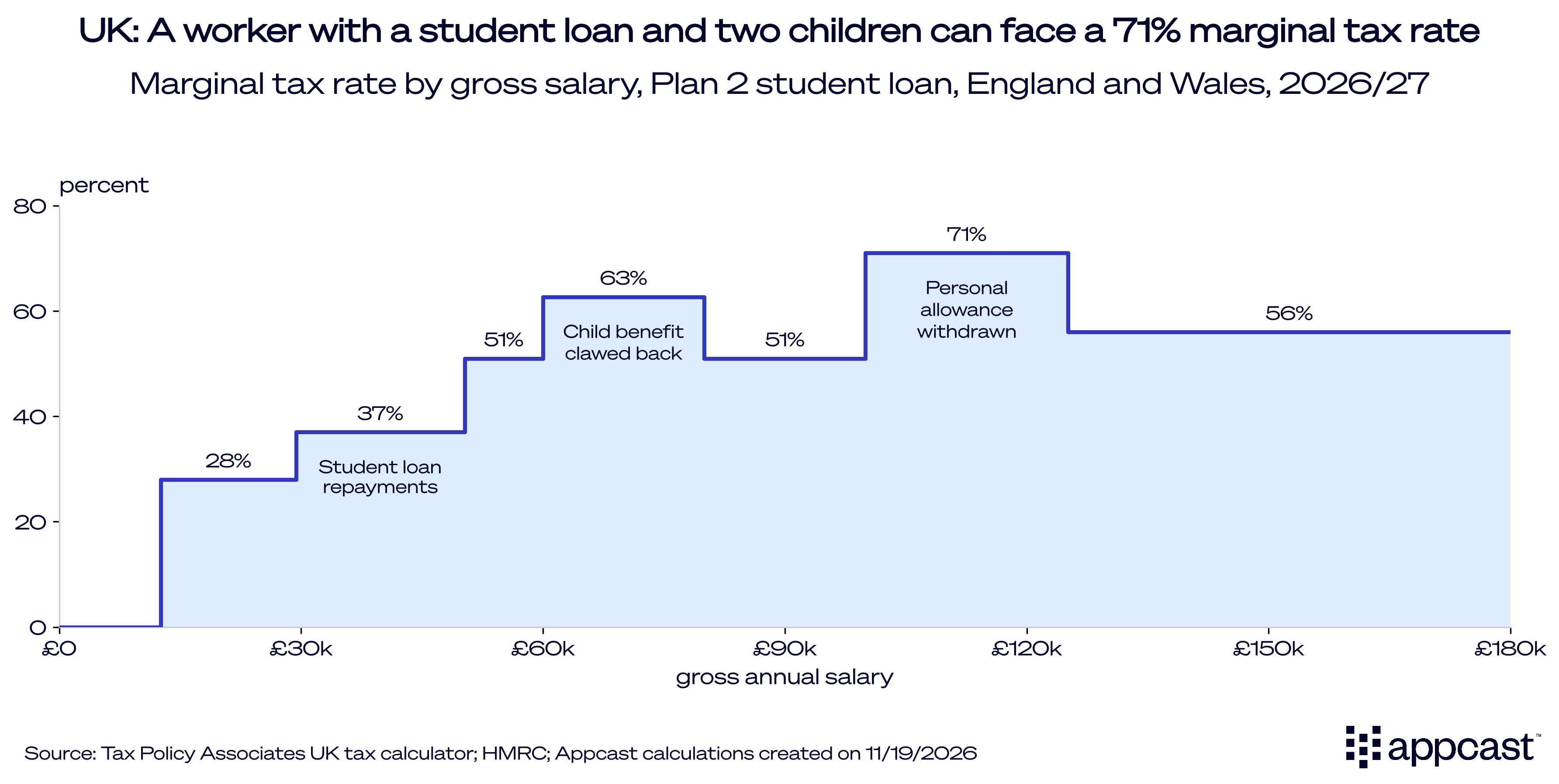
Let me explain: Marginal tax rates — how much of each extra pound of salary is taken by the government — can exceed 50% in certain cases, and more and more workers are affected. Take an employee with two children and a Plan 2 student loan. The tax rate starts at 28% once earnings pass the tax-free personal allowance. It rises to 37% when student loan repayments begin at £29,385, and to 51% in the higher-rate band. But that’s not all. Between £60,000 and £80,000, child benefit is gradually clawed back, which pushes the marginal rate to 63%. Between £100,000 and £125,140, the person keeps just 29 pence of every extra pound earned because the personal allowance is withdrawn.
And even worse scenarios are possible: The child benefit clawback grows with family size, so the rate between £60,000 and £80,000 rises to about 67% with three children and 72% with four. A postgraduate loan adds another 6 points on top. Parents of young children also face a sharp cliff at £100,000. Earning a single pound more means losing tax-free childcare worth up to £2,000 per child and some of their funded childcare hours, so a pay rise can leave a family significantly worse off. Side note: Tax Policy Associates has a fantastic calculator where you can check out the various the tax cliffs in the British system.
Faced with such disincentives, many workers have started to turn down extra hours or promotions, or to switch to part-time work. Not because they want to work less but because the system gives them little reason to work more.
What does this mean for recruiters?
Since the Global Financial Crisis, economists and policymakers have feared that British workers were becoming less productive over time relative to other advanced economies. New data shows that this isn’t the case. In fact, productivity growth outperformed most peers, and Britain’s edge has recently grown thanks to the AI boom: Output in the U.K.’s tech sector and in professional services is expanding much faster than in continental Europe.
However, that does not mean all is well. On the contrary, Britain’s “productivity miracle” is a result of declining working hours, partly by choice but not entirely. The ill-designed tax system is also to blame. It forces an increasingly large number of workers to cut hours. This “tax on ambition” is one of the U.K.’s biggest economic problems. While only policymakers can fix it, recruiters should be aware of the problem and understand how it is affecting their own workforce. The next time one of your most productive employees asks for a four-day workweek or rejects a promotion, there’s a good chance taxes are to blame!