


Photo Credit: Stefan Cosma
Armageddon or abundance?
In recent years, there has been a major debate about how AI will transform the economy and labor market. Predictions are all over the place, ranging from a doomsday scenario with massive job losses for everyone to the so-called singularity — a growth explosion that delivers a significant boost in global living standards (think Star Trek).
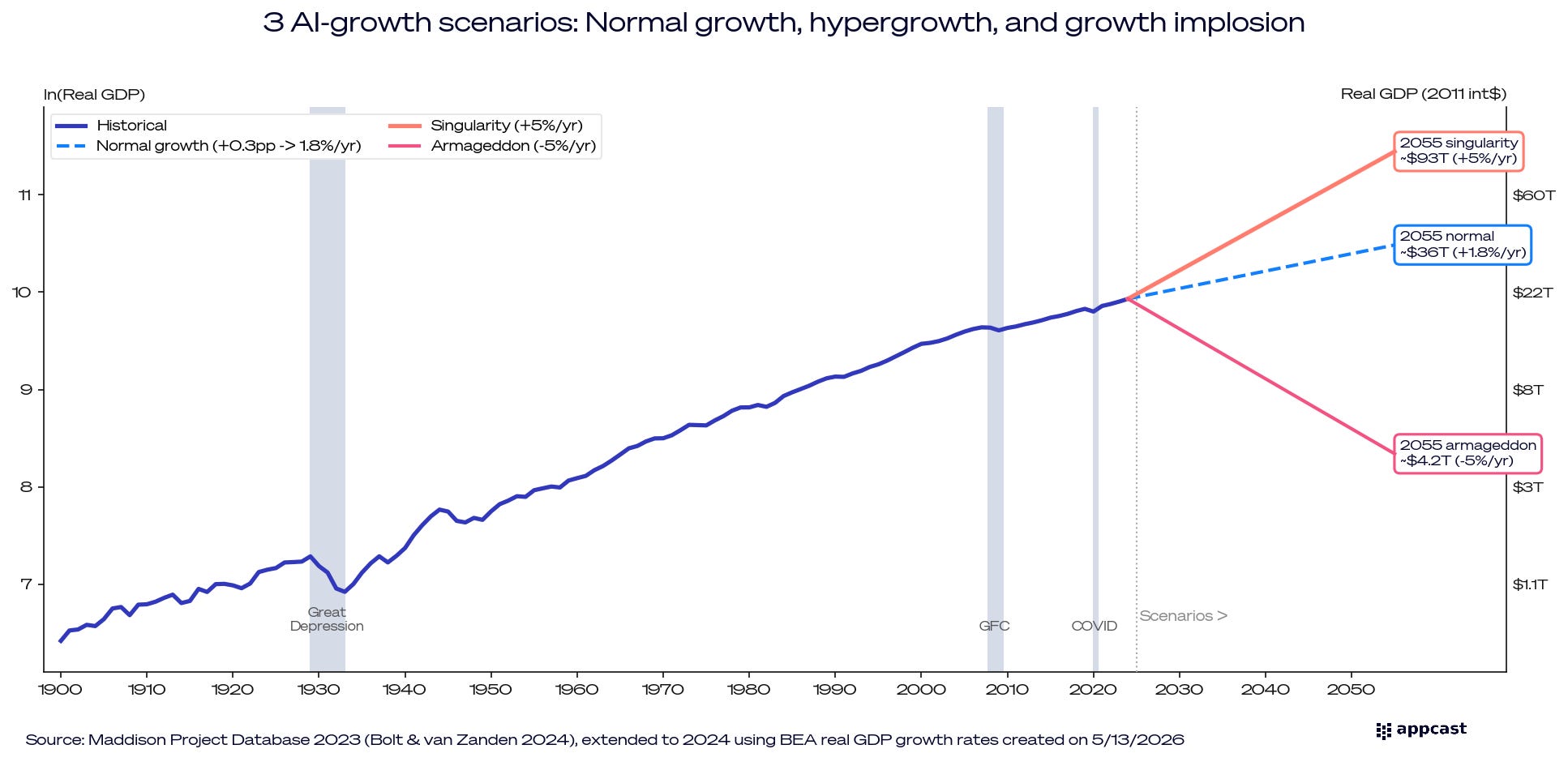
However, many of these predictions are not based on strong evidence. To better understand what might happen, we created a macroeconomic model to see how an AI boom might potentially play out.
It is important to remember that in any model there is always a trade-off between complexity and realism. It should not be overly complicated but still needs to reflect real-world conditions fairly well. The assumptions (foundations) are key.
The model: An economy with two sectors and three worker types
Here is how the model works. While you could skip this section, understanding the assumptions helps explain how things play out.
Assumption 1: The economy consists of a “physical” and a “knowledge” sector. Both combine capital and labor to produce output (stuff).
The physical sector consists of jobs that require a physical presence, hands-on skills, and human interaction. This includes essential services that cannot be digitized like health care (nurses, therapists, caretakers), housing and construction (plumbers, builders), in-person education, and food and accommodation services.
The knowledge sector, on the other hand, uses AI and skilled workers to create things like data analysis, information, and software-driven services.
Assumption 2: The knowledge sector employs routine white-collar workers and skilled knowledge workers.
Routine white-collar workers perform repetitive tasks such as data entry and basic administrative work, while skilled knowledge workers design, manage, and leverage AI to create more advanced outputs.
Assumption 3: AI capital is a substitute for routine white-collar work and a complement for knowledge workers.
This means AI can replace routine white-collar workers by automating their tasks, while simultaneously making skilled knowledge workers more productive.
Assumption 4: The model includes frictions that prevent workers from changing sectors easily.
Routine white-collar workers can move into the physical sector, but it involves a cost. Think of it as reskilling. It takes time for a secretarial worker to become an employee in the care sector. Similarly, becoming a skilled knowledge worker requires even more education and training.
Assumption 5: The physical and the knowledge sector are complementary.
Even with fast and cheap knowledge services, those services still need to be applied in the real world. For instance, AI can create the perfect surgical plan in seconds, but you still need a nurse to prep the room and a doctor to execute the procedure. AI can design optimal housing, but you still need a construction crew to build it. People also continue to demand physical goods and services, such as clothing, jewellery, furniture, dining, and entertainment. Many of these rely on workers in the physical sector.
How does the AI boom transform the workforce?
You might ask yourself now: Ok, so what does all of this mean?
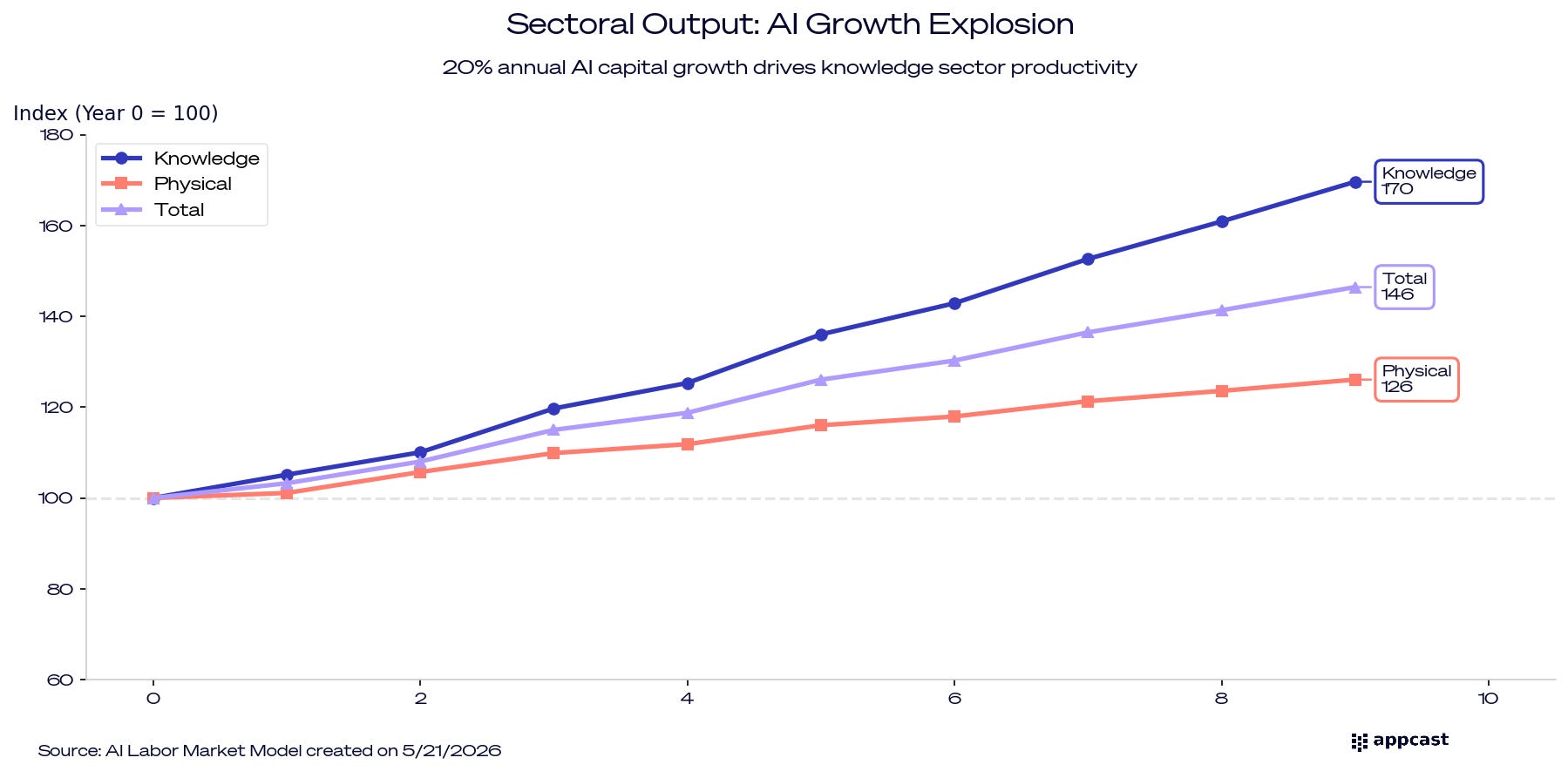
Thanks to the setup above, we can now model how an AI growth explosion might unfold. What happens to the economy and workforce if, for instance, AI capital — the stock of computational infrastructure, trained models, and AI systems that firms deploy to do work — grows by 20% each year for the next decade?
First and foremost, the surge in AI capital boosts production in the knowledge sector. But it also creates positive spillover effects for the rest of the economy, increasing production in the physical sector as well. Basically, as we produce more output with AI, demand for other goods and services like healthcare, housing, infrastructure, food and hospitality increases, too. However, this rise in economic activity does not benefit all workers equally. As the new technology spreads, there are clear winners and losers.
AI knowledge workers: Workers with AI skills benefit the most from the new technology. Their productivity rises significantly, which leads to higher wages. Because it is relatively hard for routine white-collar workers to upskill and become AI experts, the wage gap between the two types of workers in the knowledge sector starts growing over time.
Routine white-collar workers: These workers tend to lose out from the deployment of the new technology. As AI replaces many of their tasks, their productivity declines and so do their wages.
Physical workers: What happens to physical workers’ compensation is ambiguous. On the one hand, stronger demand in the physical sector pushes wages up. On the other hand, unemployed white-collar workers move into these roles, increasing labor supply and putting downward pressure on wages. Which effect ends up dominating depends on the balance between rising demand and the growing number of workers entering these roles.
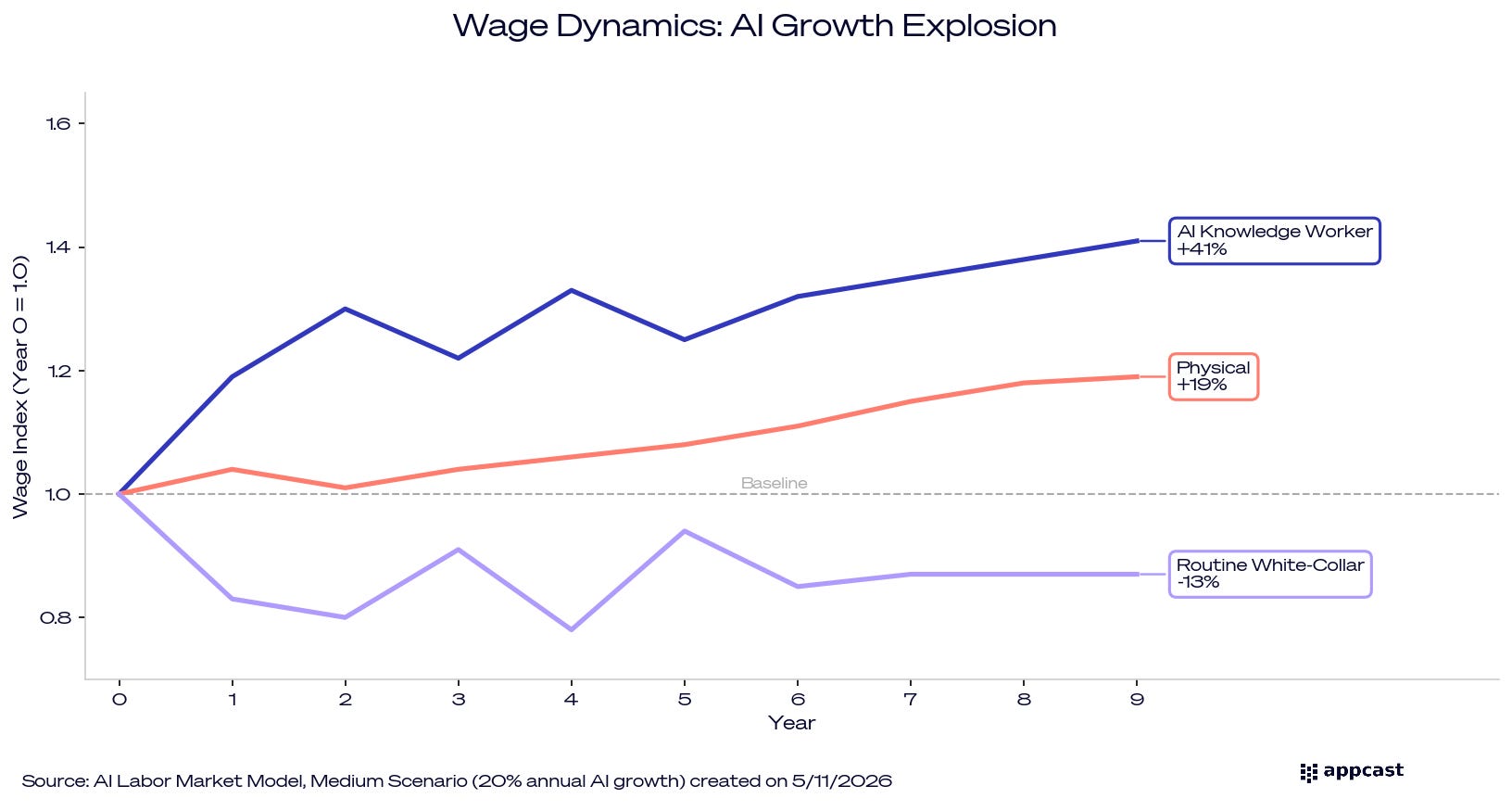
Under realistic assumptions, wages for physical workers rise over time. Thanks to the AI economic boom, the demand for physical workers increases faster than the supply of routine white-collar workers moving into the sector.
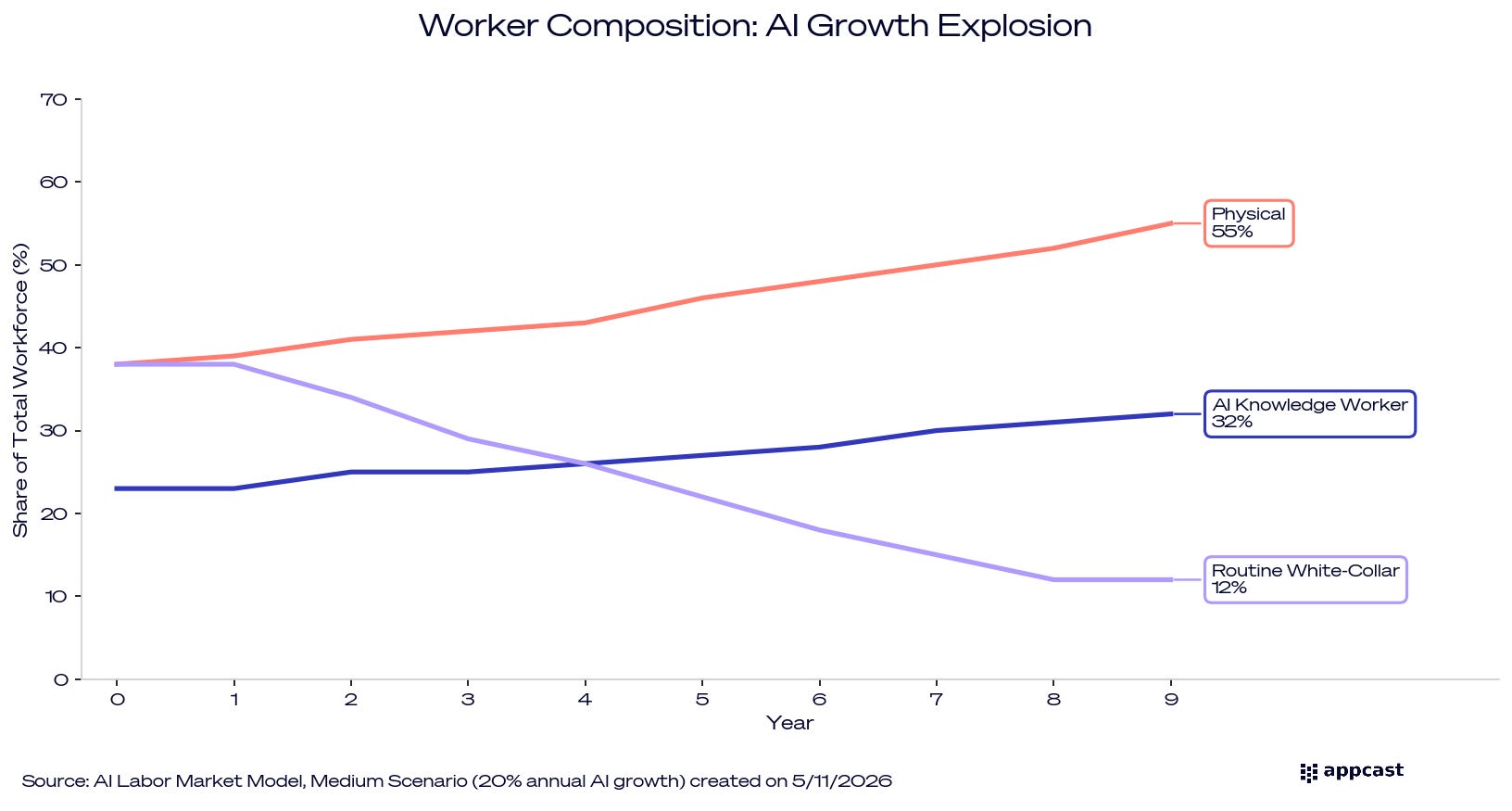
Workers might not lose overall, but the income distribution changes swiftly
What happens to the labor share — the portion of GDP paid out as salaries — is ultimately uncertain. AI knowledge workers see large wage gains. Physical workers may also benefit as the economy demands more of the tasks that AI cannot perform. Meanwhile, routine white-collar workers lose ground.
Whether the overall labor share rises or falls depends on whether higher wages for AI knowledge workers and physical workers offset the declining wages for routine office roles.
Total wage income in the economy can remain roughly flat while the distribution of that income changes dramatically. Inequality between AI-complementary workers and the rest widens, but the picture is more nuanced across the lower and middle parts of the income distribution. Physical workers, historically the lowest-paid group, may see their wages catch up to or even surpass those of routine white-collar workers.
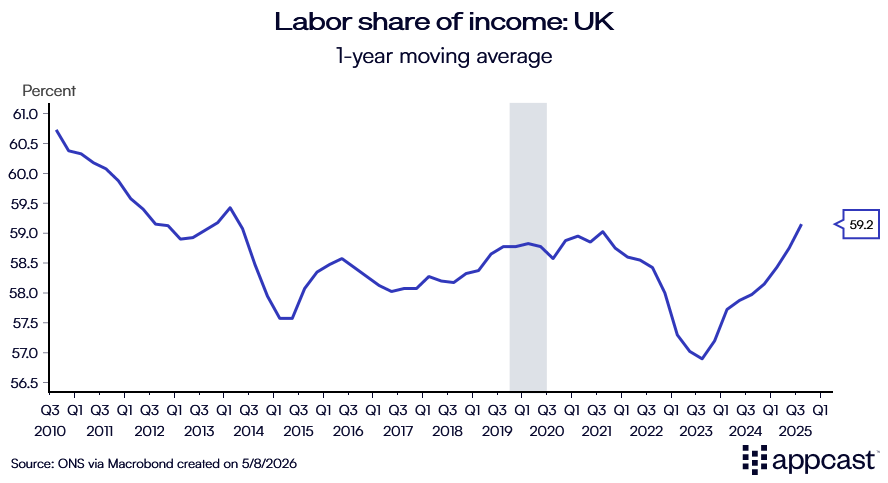
Recent data shows us that the story is complicated. While the U.S. labor share has fallen since the pandemic, the opposite is true for the U.K. Structural shifts in who earns what can happen even as the total share going to workers moves only modestly.
Are other scenarios possible?
Clearly, yes.
One extreme scenario is that AI becomes a labor-displacing technology for all workers in the knowledge sector. In that case, both knowledge and routine white-collar workers lose their jobs, pushing more people into the physical sector and putting downward pressure on wages. Productivity still increases, but the gains accrue to AI capital owners. This raises inequality and eventually slows economic growth due to a decline in consumption.
Another possibility is that AI-driven output and physical production are not complementary, meaning that more and more value is created in the knowledge sector alone. In this case, inequality would rise sharply, as only knowledge workers benefit while the labor share plummets. Growth would again be limited by weak consumer spending. This outcome, however, appears even less plausible. Physical goods and services — from housing and food to transport and care — remain central to the economy, and human labor is likely to stay essential in their production.
Summing up
AI will fundamentally reshape the labor market. Some jobs will disappear, others will change, new jobs will be created, and the gains will not be evenly shared. While our model assumes an extreme AI growth scenario, the direction of travel is clear: routine white-collar workers lose out as AI replaces their work. The physical sector initially benefits from higher AI-driven output, raising demand for housing, healthcare, infrastructure, food, and leisure — and lifting wages. Over time, displaced white-collar workers flow into physical roles, increasing the supply of labor and capping further wage growth.
The effects on inequality and the labor share are harder to pin down, but the winners are not: skilled knowledge workers benefit the most, as AI strongly complements their tasks, driving sharp gains in productivity and wages.
In a follow-up post, we will show that several of these dynamics have already started to unfold since the release of ChatGPT in late 2022 — and explore what that means for recruitment.