

Photo credit: Yannic Kreß
Following roughly two decades of ultra-conservative fiscal policy, Chancellor Friedrich Merz decided in early 2025 that the threats of this decade were serious enough to warrant a complete U-turn: a massive fiscal stimulus was announced — the “Sondervermögen,” loosely translated as “special fund.” Some €500 billion was set aside for investments in infrastructure and renewable energy, and defense spending was exempted from the constitutional debt brake. While the sums involved were of unprecedented scale, Germany’s economy continued to stagnate throughout 2025. The key constraint: the funds were deployed at a slower pace than expected due to bureaucratic hurdles. However, economic figures for this year are signaling that the German economy is finally accelerating. This also has implications for the labor market. The demand for workers in certain industries — defense, aerospace, construction, and energy — is rising rapidly, putting further pressure on employers filling specialist roles.
Revised data shows German growth accelerating
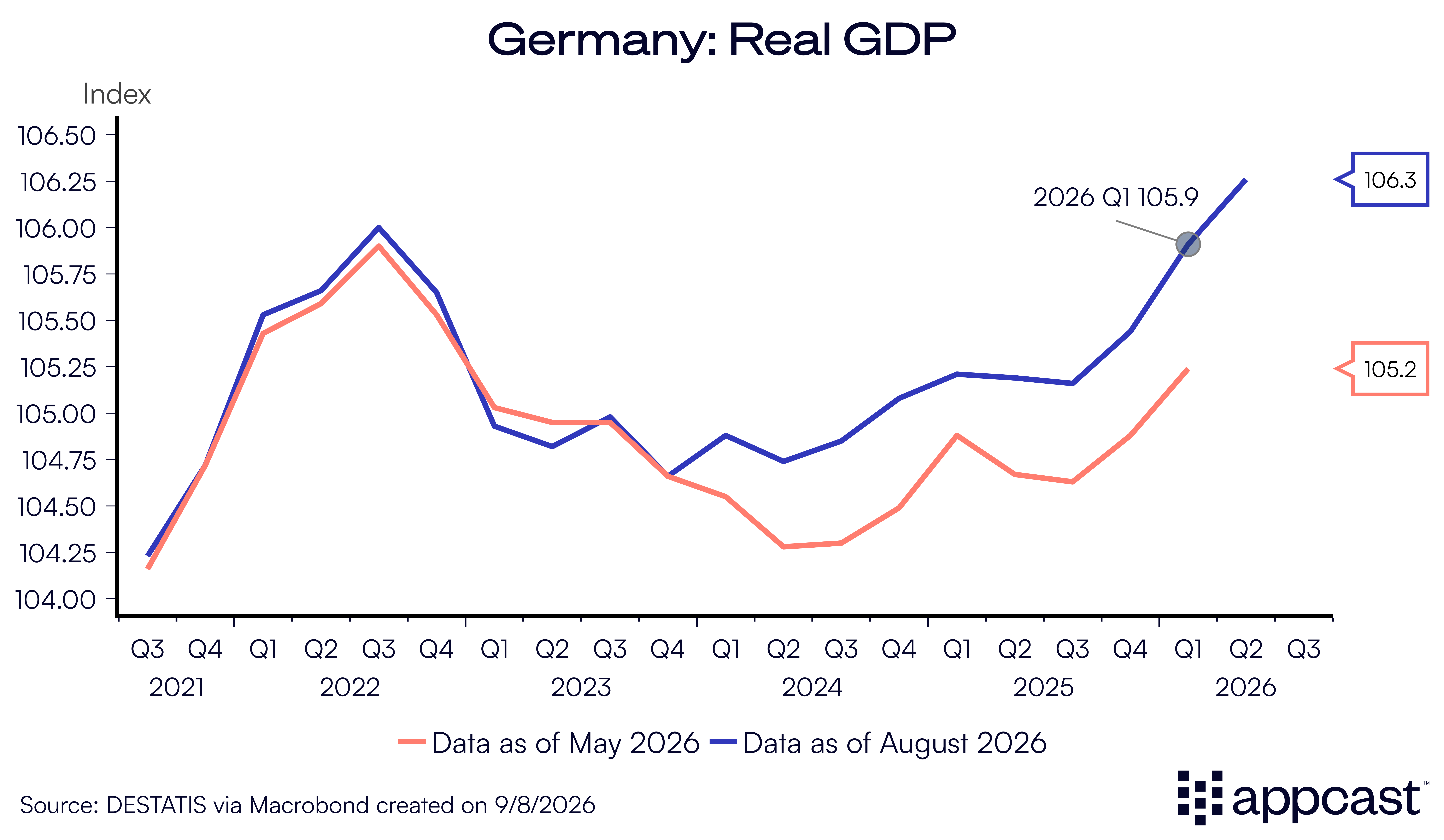
Germany’s economy was supposedly stagnant throughout 2025, and this year’s oil shock and shipping disruptions due to low water levels on the Rhine added to the concern that an economic revival would remain elusive. However, data revisions released in August show that the economy has performed slightly better since 2024 than earlier estimates indicated. The revised figures imply that first-quarter GDP this year was about 0.7% higher than previously thought.
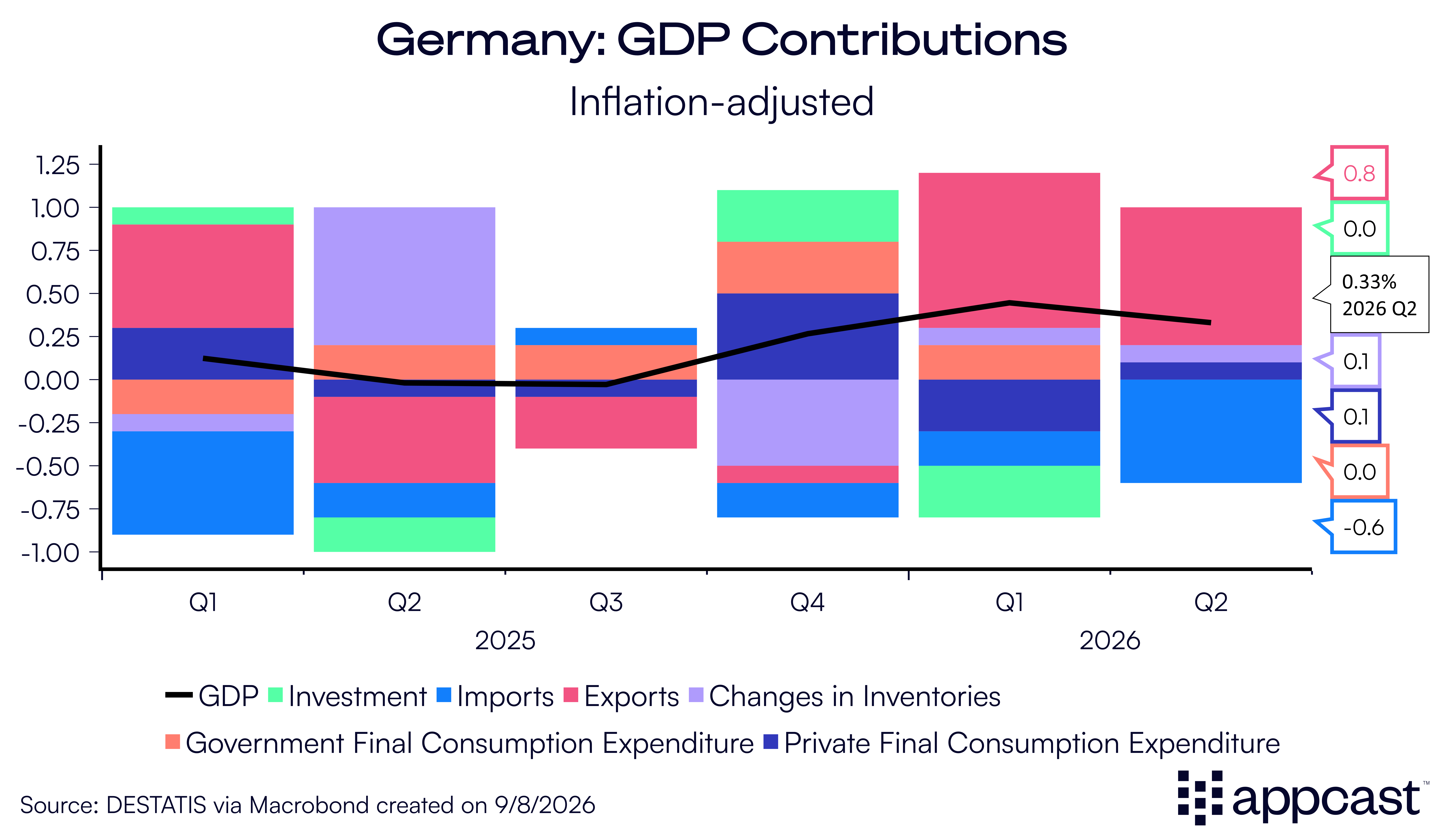
Looking at GDP contributions, one can see how fiscal policy is doing the heavy lifting. Since the second quarter of 2025, Germany’s economy has grown at an average quarterly rate of just 0.2% (about 0.8% annualized growth) — and of that, government consumption has contributed about 0.18 percentage points per quarter. In other words, the vast majority of Germany’s already modest growth over the last five quarters has come from fiscal spending, with net exports supplying most of the rest. The bright spot is the trajectory: on an annualized basis, economic growth has accelerated from roughly 0.5% in the second half of 2025 to about 1.5% in the first half of 2026.
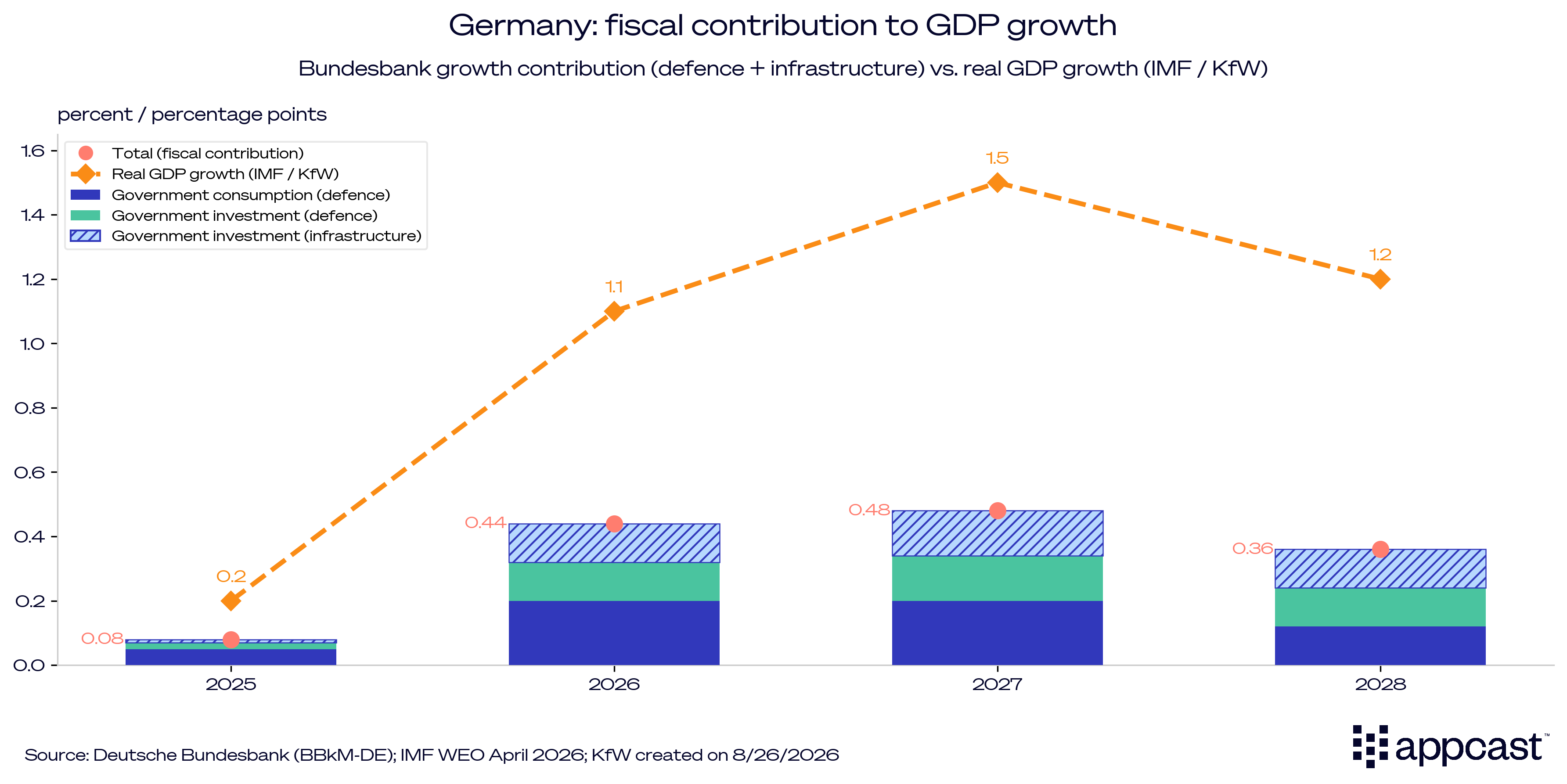
As a result, updated growth projections now expect that the economy will expand by about 1.1% in 2026, followed by 1.5% in 2027. A study by the Bundesbank, Germany’s central bank, estimates that about 0.44 percentage points this year, and slightly more next year, will come from government spending on defense and infrastructure — roughly 40% of the total. That may well understate the fiscal contribution, since higher government spending can also boost private sector confidence and therefore stimulate additional business investment and consumer spending.
The fiscal boost is showing up in defense and infrastructure
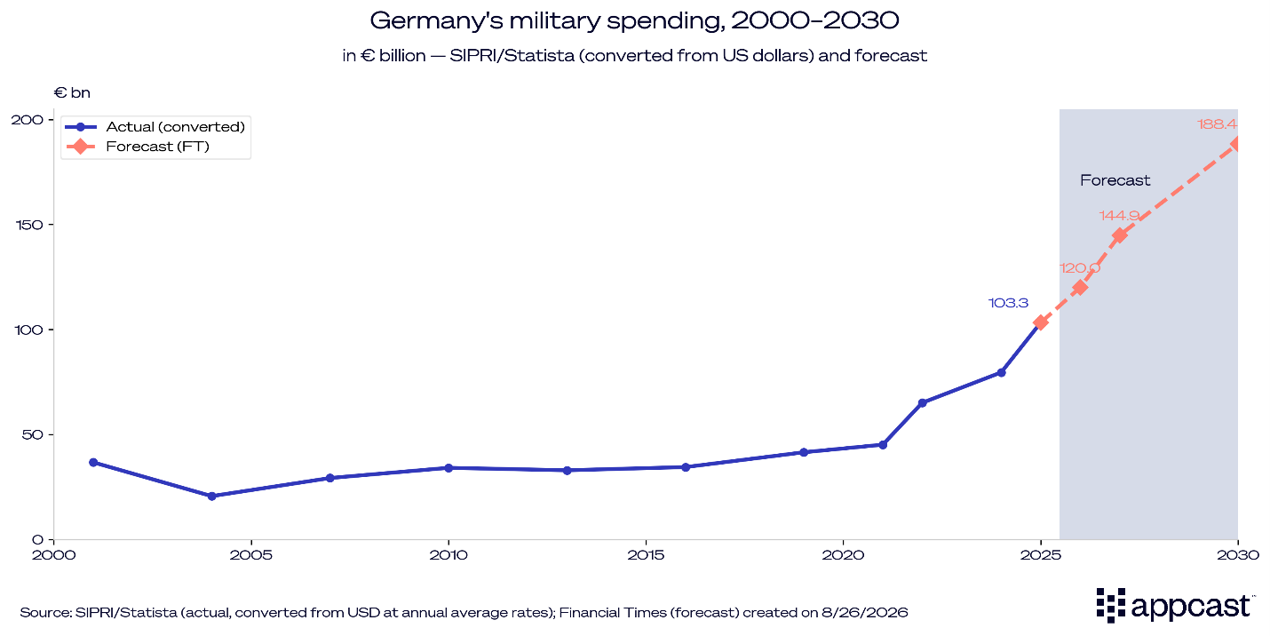
Within half a decade, Germany’s military spending roughly doubled from less than €50 billion in 2019 to about €100 billion last year, with projections showing a further increase to about €144 billion by 2027. The rearmament has catapulted Germany to become the biggest military spender in Western Europe, and the fourth largest in the world.
Of course, higher military spending does not always translate into increased economic activity. Buying American fighter jets would do nothing for German production. But Germany’s defense industry on its own is large enough to fulfill a significant share of the arms orders the German armed forces require in the years to come.
On top of higher defense commitments, there is a noticeable increase in infrastructure spending that is being funneled into the German economy. After more than 15 years of underinvestment, funding for rail infrastructure surged from about €10 billion in 2023 to just under €20 billion in 2025. Total federal investment is projected to double between 2024 and 2026 from less than €60 billion to about €126 billion, with the special funds for infrastructure and climate accounting for more than half of that total.
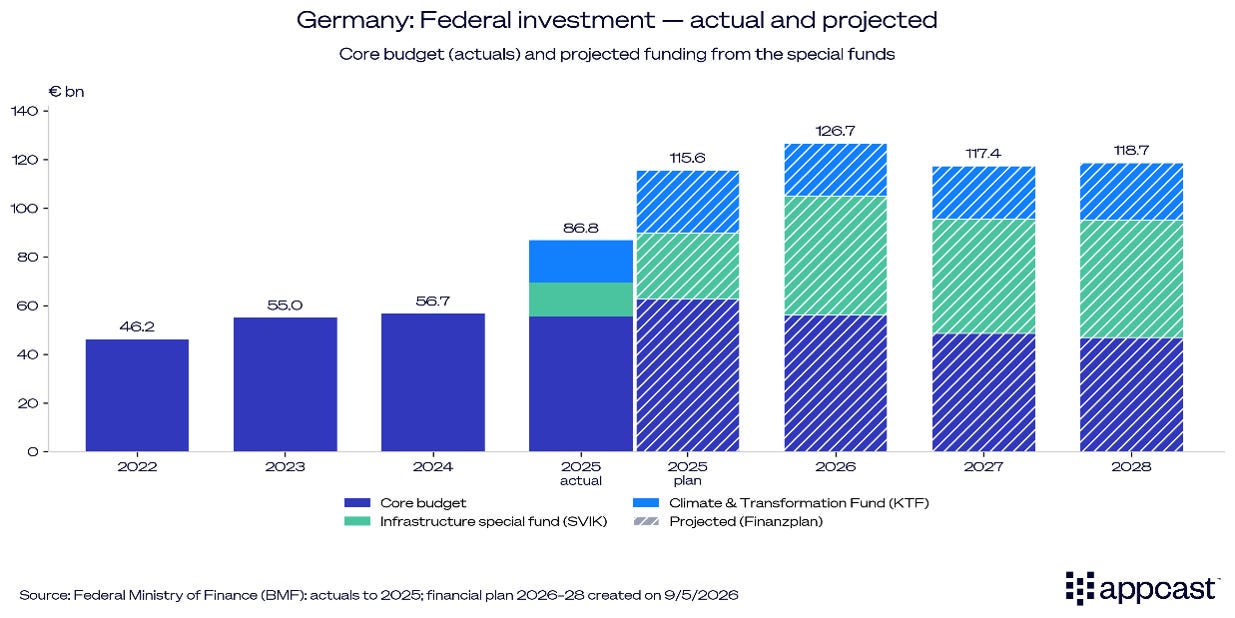
Note: Figures include financial transactions (e.g. rail equity and loans) that count as investment under budget law but aren't real fixed investment — most notably inflating 2025.
Manufacturing orders are bouncing back
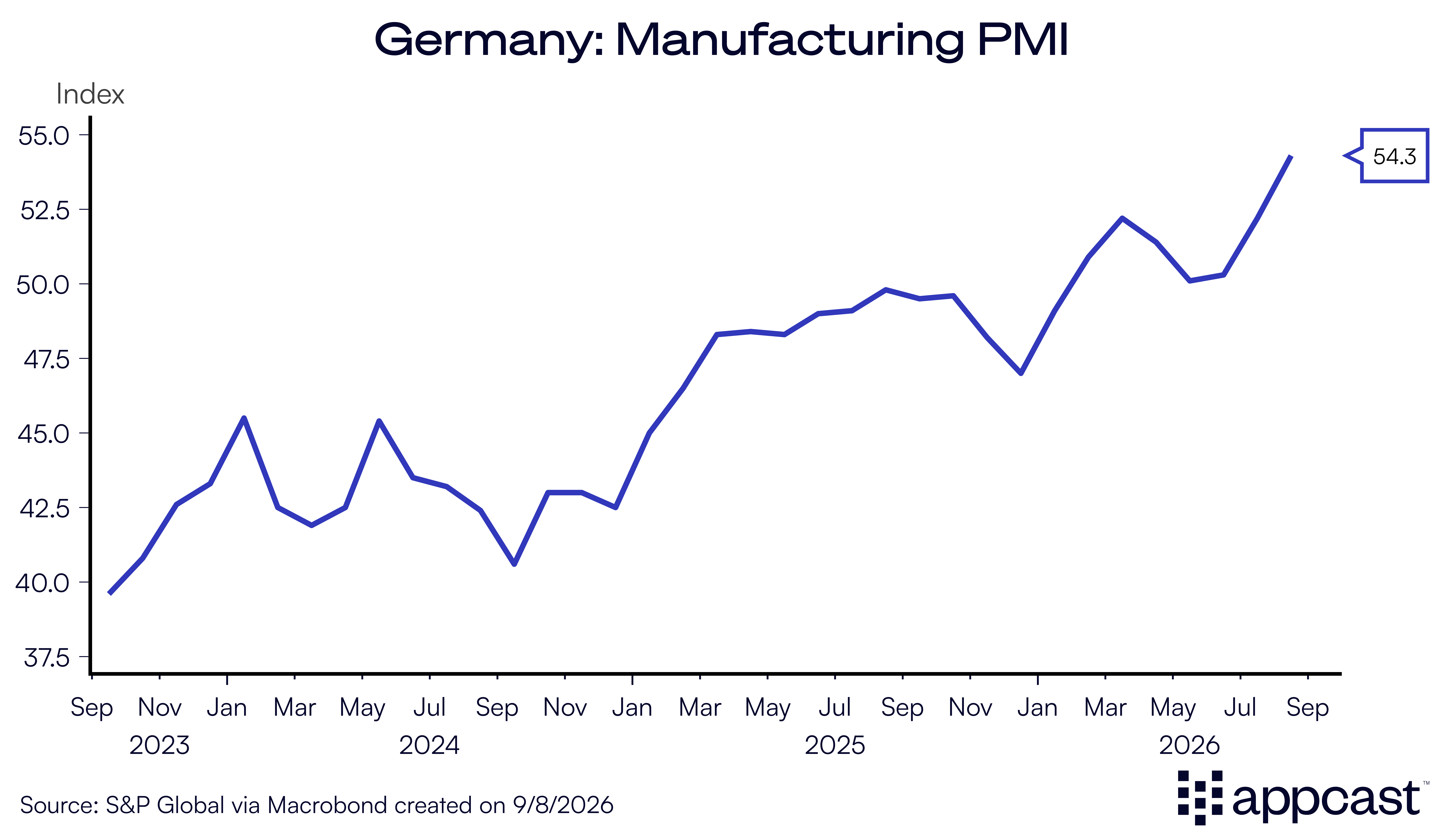
Another positive trend: Germany’s exports are finally gaining momentum again. For the first time since early 2024, trade is set to make a positive contribution to annual GDP growth. The industrial sector, specifically, is benefiting from a more supportive global business environment as the AI investment boom lifts growth around the world. Manufacturing orders are increasing as the demand for German products picks up, especially in fast-growing Eastern European economies. As a result, Germany’s manufacturing PMI (Purchasing Managers’ Index) has risen to its highest level in more than four years.
The rise of the far-right should be a genuine concern
Just as fiscal spending finally revives growth, political instability is deepening. The Alternative für Deutschland (AfD) just won the state election in Saxony-Anhalt and will likely govern there, which would mark the first time since World War II that a far-right party has held power. Even though the state just has 2.1 million people, the political fallout is substantial and could threaten the current economic recovery. Germany’s boom is running straight into a wall of worker shortages, which can only be filled with skilled immigration. The AfD’s defining policy is not just to slam that door shut, but to push migrants back out. The party is also opposed to the very debt-financed stimulus now supporting growth. A stronger far right raises questions about whether Merz’s reform packages and fiscal continuity will survive. Add the AfD’s sympathies for Putin, its Euroskepticism, and the reputational risk of doing business in a state it governs, and you get exactly the kind of uncertainty that makes firms hesitant to hire and invest. In other words, the political headwind might start canceling out the fiscal boost right when Germany can least afford it.
What does this mean for recruiters?
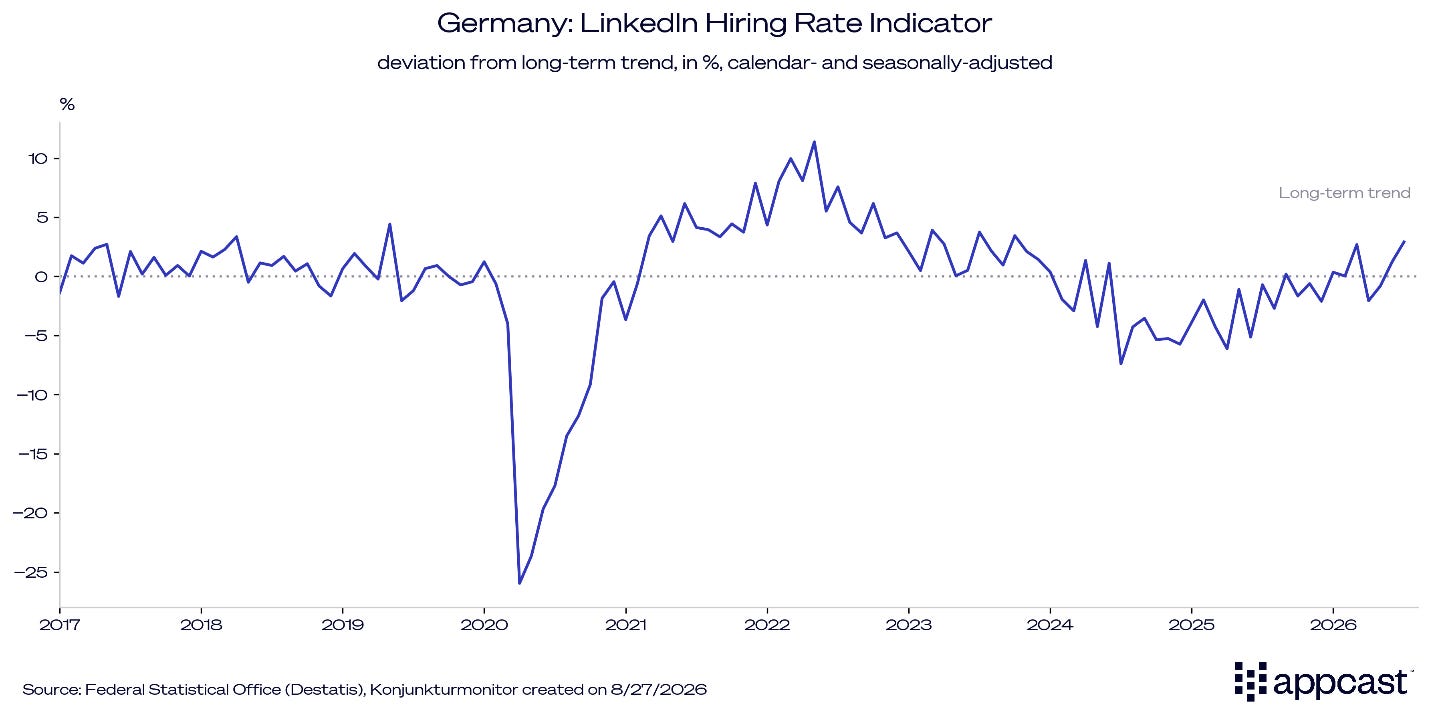
Broadly speaking, the German labor market remains sluggish after more than five years of stagnation. However, there are signs of economic revival as growth is picking up. More importantly, LinkedIn’s hiring indicator has recently risen above its long-term trend, a first since early 2024.
The surge in public investment is already heating up specific pockets of the labor market. The money is flowing overwhelmingly into skilled trades tied to construction, energy, and defense, which are precisely the occupations where shortages are most acute. Expect intensifying competition, upward wage pressure, and longer time-to-fill in exactly those segments, even as the wider labor market recovers more slowly.
The winners will be recruiters who move early and build talent pipelines in skilled trades before the demand wave fully lands. That means leaning harder into apprenticeships and reskilling, retention over replacement, and international sourcing because domestic supply can’t cover the gap. However, the AfD is the political wildcard that cuts right through this strategy: labor shortages will become even more entrenched if immigration tightens under a stronger far right.