


Photo credit: Etienne Girardet
Yes, the title is borrowed from an earlier article we published on the U.S. using Appcast’s proprietary Recruiting Difficulty Score. In this piece, we rank the hardest-to-fill occupations in Germany based on official labor market data. We also show how worker shortages are highly correlated with vacancy duration and wage growth.
Germany’s occupation shortage ranking
Germany’s Federal Employment Agency has created a worker shortage analysis for 519 distinct occupations. These are sorted into three different groups according to their skill and education requirements.
Skilled workers: “Fachkräfte” in German, which loosely translates to skilled workers. These are jobs that require completed vocational training (typically 2 to 3 years) or a comparable qualification, covering skilled tasks such as those of an electrician, nurse, or cook.
Specialists: Jobs needing qualifications beyond basic vocational training, such as a master craftsman (“Meister”), technician diploma, or bachelor’s degree. They typically involve more complex work with planning or supervisory responsibility.
Experts: Highly complex roles that generally require at least a four-year university degree (master’s level or above), spanning leadership, research, and strategic or highly specialized professional work (e.g., physicians, engineers in senior roles, and academics).
Note how this classification leaves out any job with minimal skill or educational requirements. This is by design, as such occupations are arguably not constrained by labor shortages.
The occupation shortage score is based on six different indicators, each capturing some aspect of labor market tightness.
Median vacancy duration: A hiring difficulty measure capturing how long it takes to fill a job.
Jobseeker-to-vacancy ratio: A measure of candidate supply versus labor demand.
Unemployment rate by occupation: A measure of labor supply.
Employment change of foreigners: A measure of hiring difficulty. It captures how employers respond to domestic labor constraints.
Exit rate of unemployed workers: This captures the speed at which workers within an occupation re-enter the labor market.
Median wage growth: A measure of wage pressure reflecting competition among employers for labor.
Here is how the score works. A value below 1.5 indicates that the occupation does not have any worker shortages (“no bottleneck”). Jobs between 1.5 and 2 are “under observation”, while any occupation scoring 2 or higher is classified as a “bottleneck occupation”.
The 20 jobs with the highest shortage score
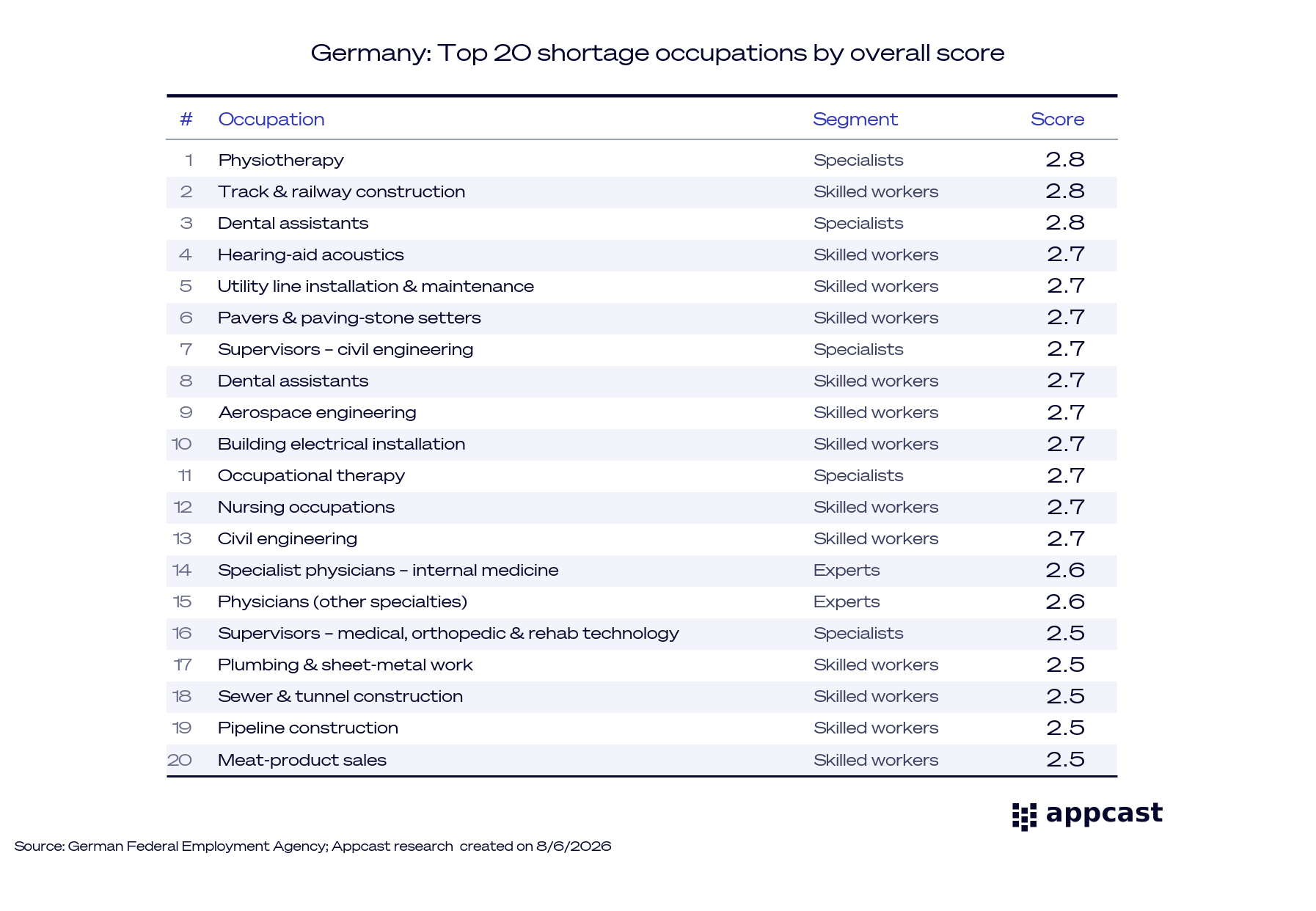
Two things stand out when looking at the list of the 20 hardest-to-fill jobs below. Just like in the U.S., recruiting for certain healthcare roles is extremely difficult. A rapidly aging society leads to surging demand, while licensing restrictions and educational requirements constrain candidate supply. Physiotherapists, dental assistants, and nurses are among the jobs with the highest shortages, while many of the other occupations are related to infrastructure. What all of them have in common is that they are “physical jobs” — by that, we mean that they require a physical presence and cannot be performed remotely.
Fact 1: Jobs requiring less education face bigger worker shortages
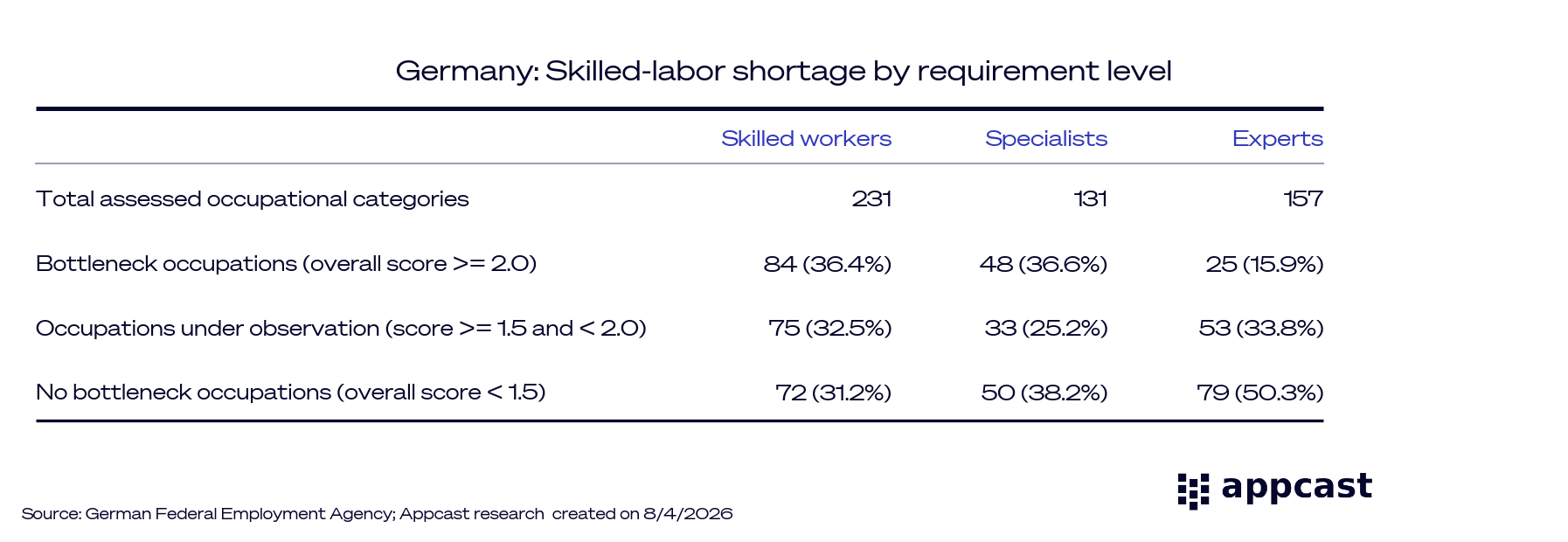
The next table summarizes how many jobs are in each shortage category for the three different skill levels. What is striking is that skilled workers — needing the lowest degree requirement — experience the highest occupation shortages. 36% of jobs in the skilled worker category are bottleneck occupations, with another 32% being under observation. This is higher than for specialists and experts. Jobs with the highest degree requirements are, ironically, more often classified as no bottleneck.
Fact 2: Jobs requiring less education take longer to fill
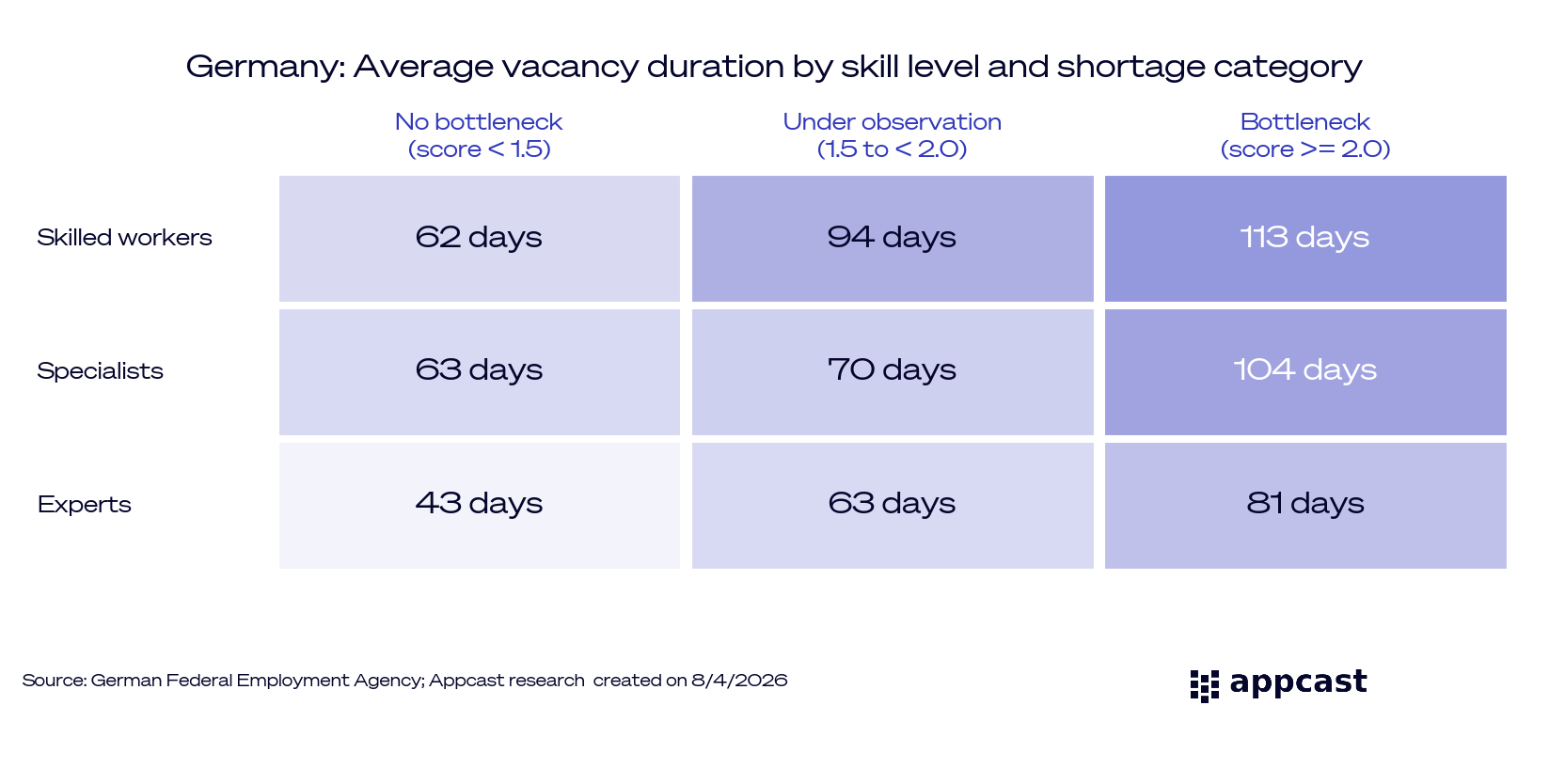
One of the more relevant metrics going into the shortage score is vacancy duration. It is extremely costly for companies to leave jobs unfilled. Elevated vacancy duration is therefore a good indicator of recruitment difficulty. The data shows that positions for skilled workers take by far the longest to fill across all shortage categories. The gap between experts and skilled workers ranges from 19 days in no-bottleneck occupations to 32 days in bottleneck ones.
Fact 3: Jobs requiring less education see faster wage growth
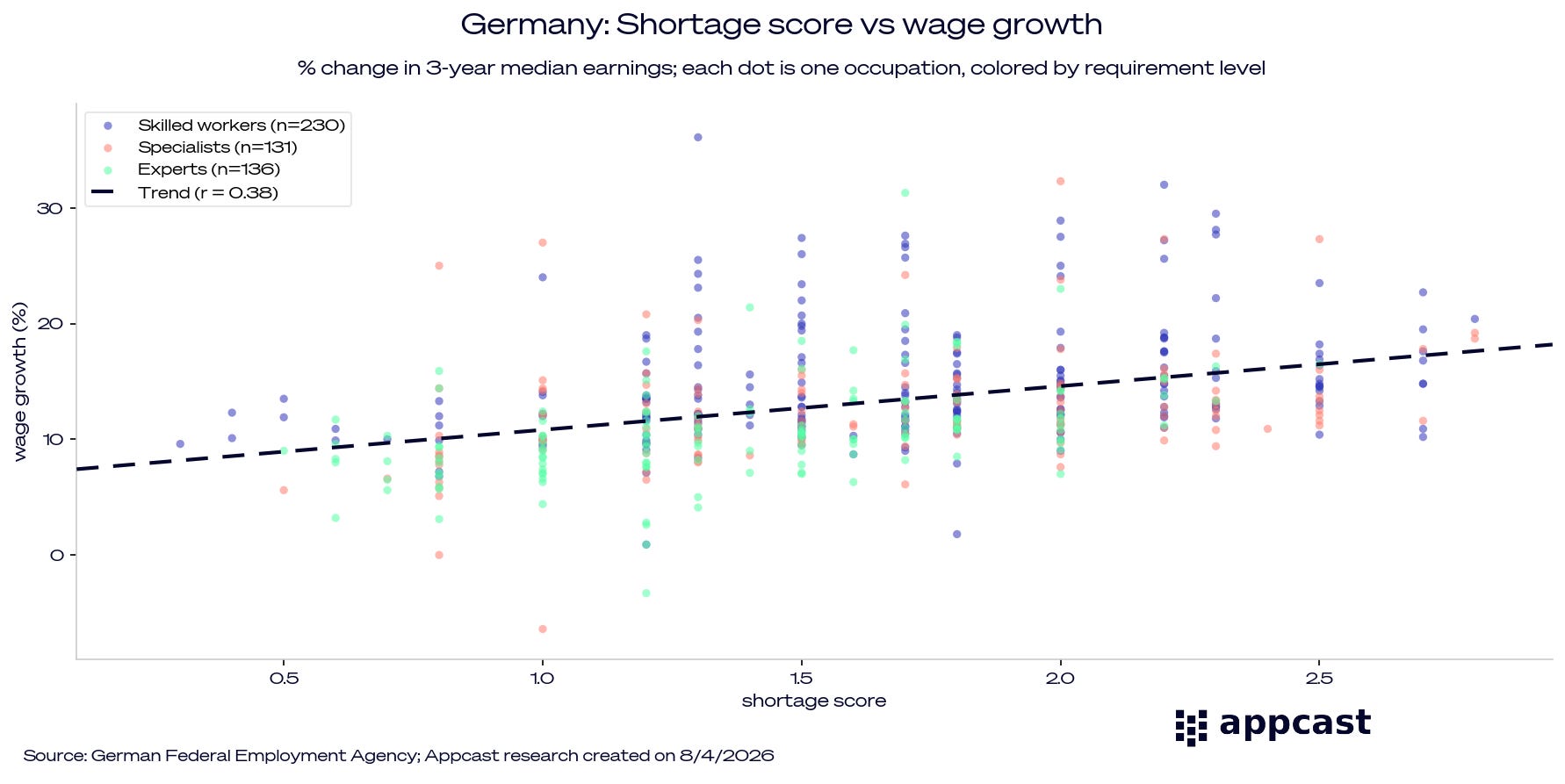
The law of supply and demand also holds for the labor market. All else equal, an increase in demand causes prices to rise. For workers, this means higher wage growth in occupations with a higher shortage score. As expected, bottleneck occupations have experienced much faster pay gains compared to no-bottleneck occupations over a three-year period between 2021 and 2024. For skilled workers, the difference is 3 percentage points, while for experts it’s closer to 4.
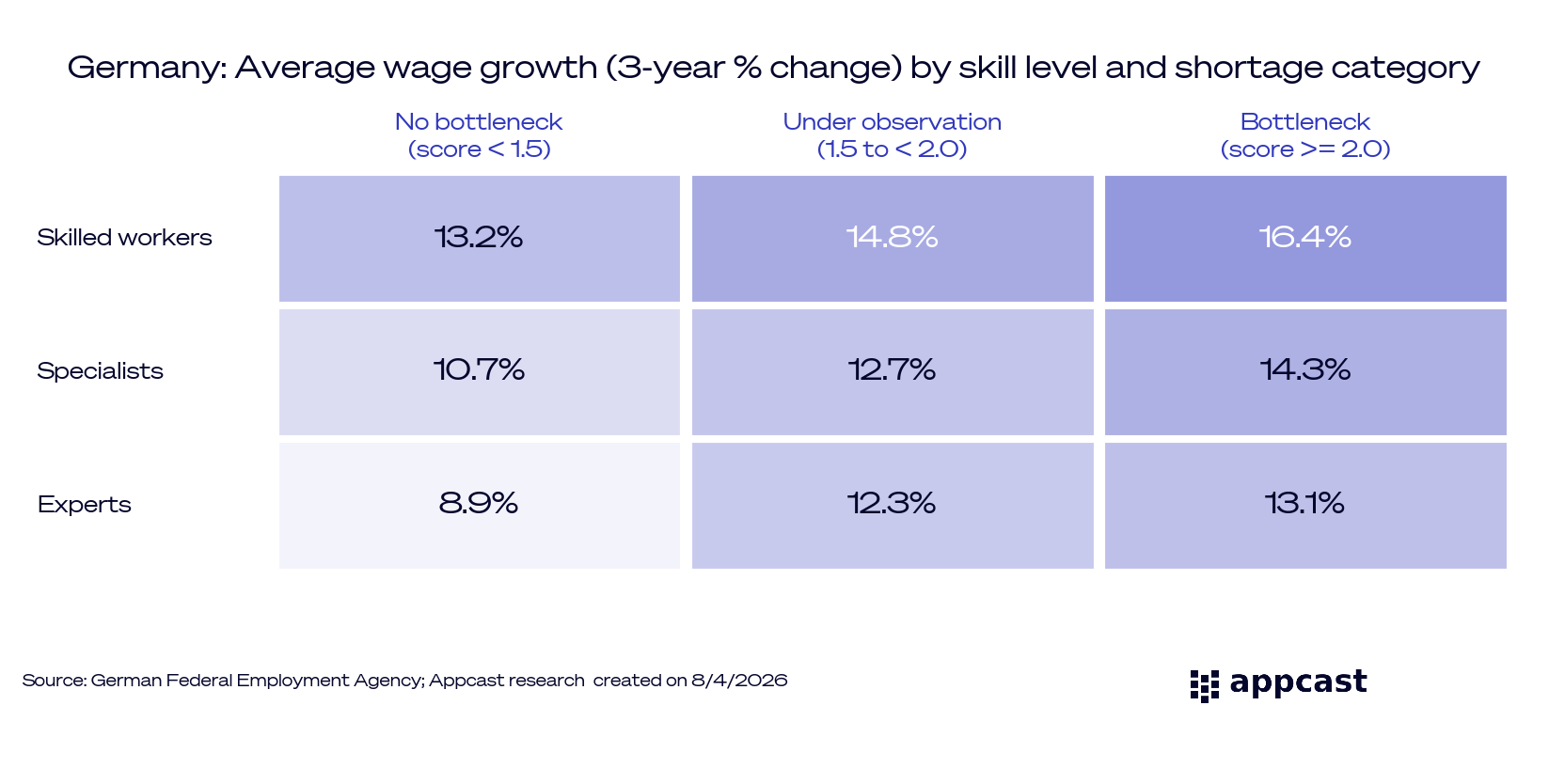
Skilled workers are experiencing significantly higher wage growth across all categories, while wages for experts are slightly more sensitive to the occupation shortage ranking. This likely reflects tighter, more specialized labor markets where scarce experts can command bigger premiums relative to their peers. Skilled-trade wages, on the other hand, are more anchored by collective agreements and broader labor supply.
Using data for all 519 jobs, we find that a 1-point increase in the shortage score is associated with a 3.8 percentage point increase in three-year wage growth. Across the observed score range (about 0.3 to 2.8), the line rises from about 7% predicted wage growth at the low end to 17% at the high end. While the relationship isn’t perfect, occupation shortages are an important determinant of compensation trends.
Fact 4: Infrastructure is facing the biggest labor constraints
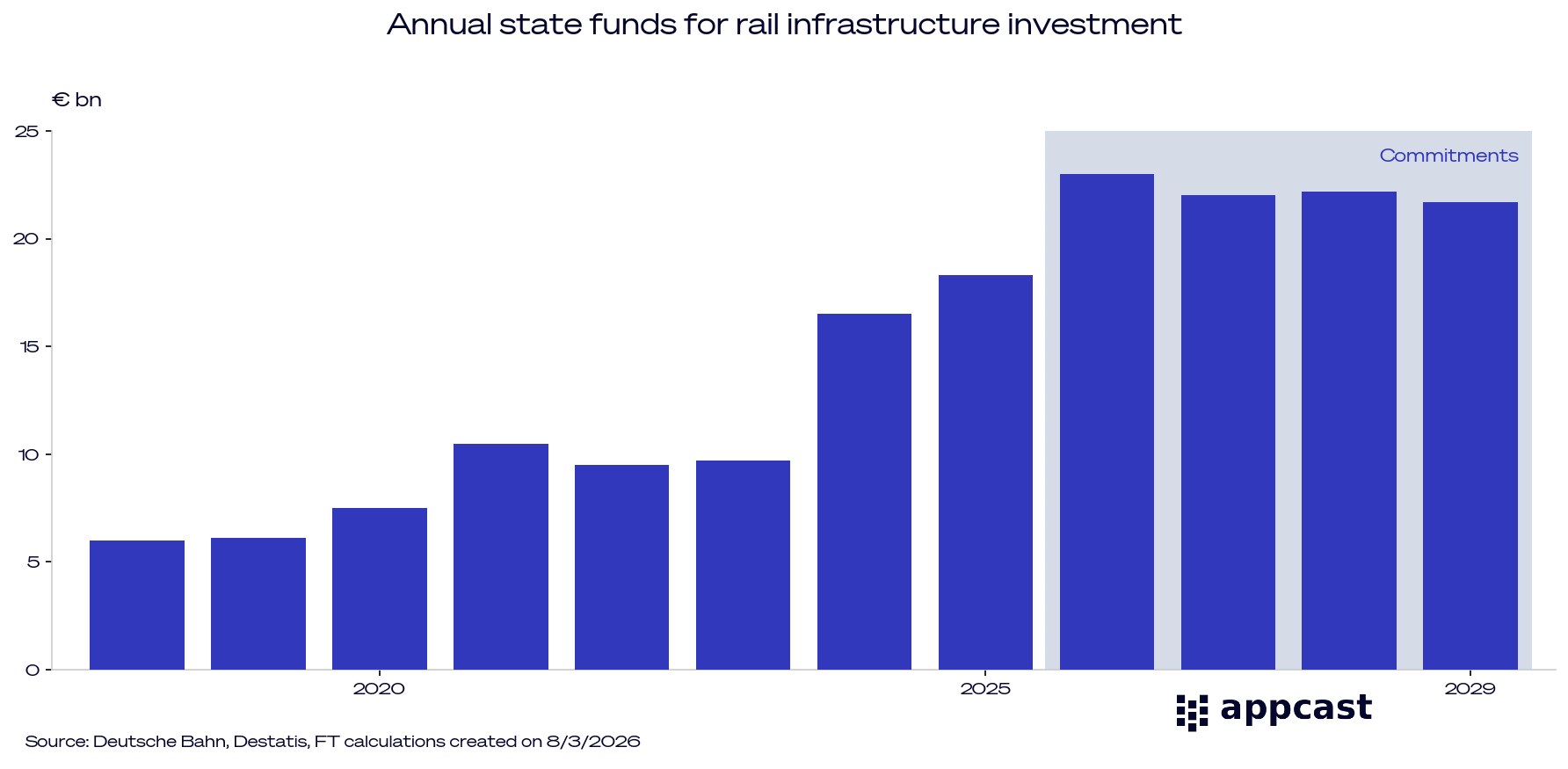
Digging deeper into the skilled trade category, we find that a significant share of high-labor-shortage occupations is related to infrastructure. Powerline maintenance, crane operation, and railway, road, sewage, and pipeline construction are all occupations that exhibit both very high shortage scores and elevated wage growth. This is a harbinger of things to come as the German stimulus funds are finally being deployed. After decades of underinvestment, infrastructure spending is soaring, with funds for railway investment projected to be around €20 billion this year — up from less than €10 billion just a couple of years ago. Even adjusted for inflation, that's more than 50% above pre-pandemic levels.
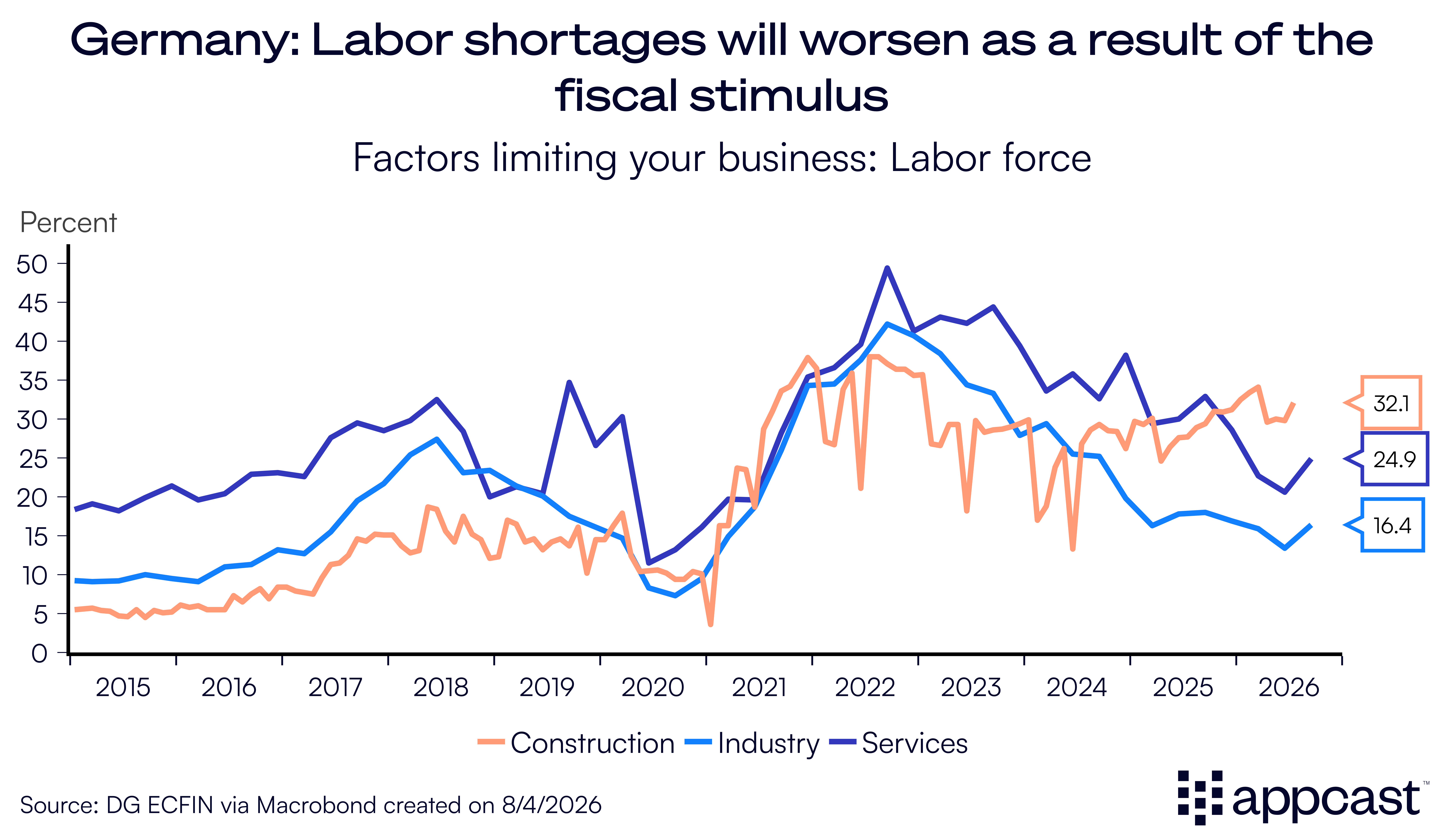
However, economists anticipate that this rapid inflow of money will aggravate supply constraints, particularly when it comes to the available workforce. As our data shows, skilled-worker occupations are already topping the shortage list. About a third of businesses in construction report that worker shortages are constraining their output, a much higher share than just a few years ago.
It is very likely that these problems will only get worse in the coming years due to rising demand. Germany’s fiscal stimulus might therefore run into some considerable supply constraints, with input prices soaring and projects being delayed due to domestic worker shortages.
What does this mean for recruiters?
We have shown in prior research how the AI economy is creating some unexpected winners, namely specialized blue-collar workers in infrastructure-related roles. The data center construction boom, the green energy transition, higher global defense spending, and rising healthcare needs are all increasing the demand for physical workers.
Zooming in on the German labor market, we see this happening. Our list of the 20 hardest-to-fill jobs is dominated by roles in healthcare and skilled trades, particularly in construction and infrastructure. They are experiencing rapid wage growth and significantly longer vacancy duration, as recruiters struggle to fill these positions. This is, of course, exactly what one would expect to see in sectors where rising demand meets constrained labor supply. If you were hoping for conditions to improve, I’ll have to disappoint you. With Germany’s fiscal stimulus colliding with the country’s rapidly aging workforce, recruiting difficulties for many of these roles will only increase.
Last call to join us: The Recruitonomics team is hosting a Substack live event on Aug. 7 to break down the U.S. July jobs report, released earlier that morning. Use this link on the day!