


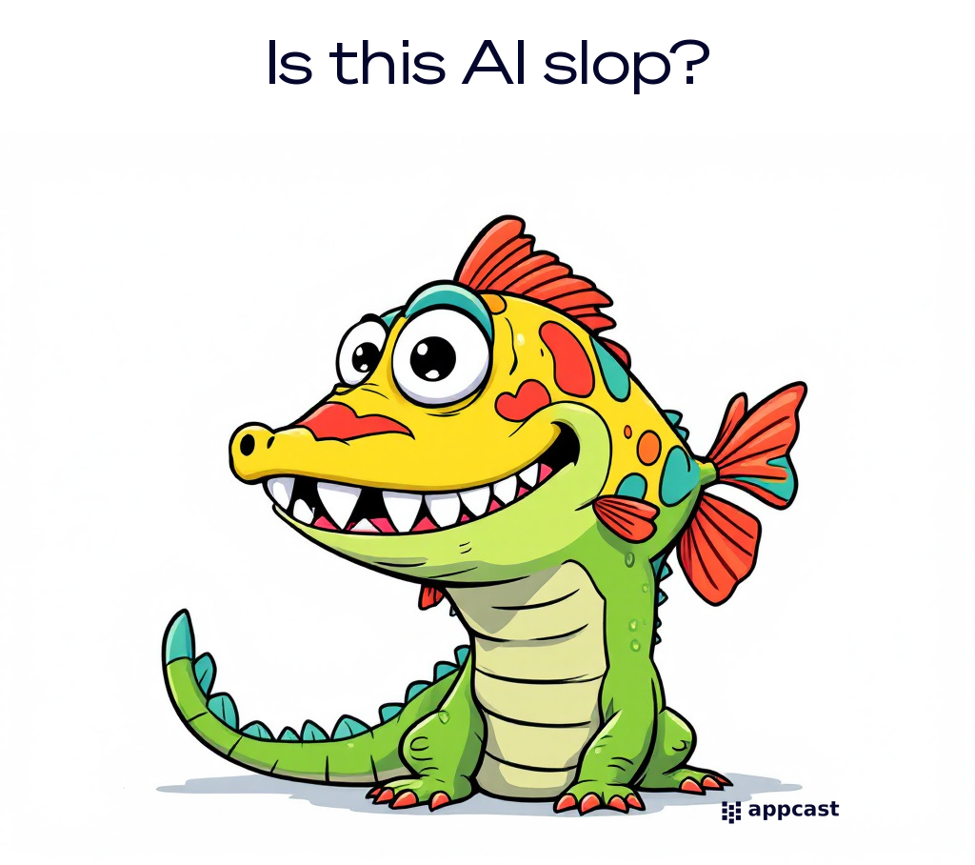
In light of the most recent controversy, an op-ed in the Financial Times that was supposedly majority-written by AI, we believe it is important to inform our readers about our internal AI policy. Here is how the Recruitonomics team uses artificial intelligence for research and for writing:
1. Our pieces are written by humans (well, economists)
Recruitonomics is not producing AI slop! All of our pieces are human-written; we do not allow AI to write a large share of our content. You can double-check this yourself using Substack’s recently implemented AI detector called Pangram, which works for all articles published after July 20, 2026. Example:
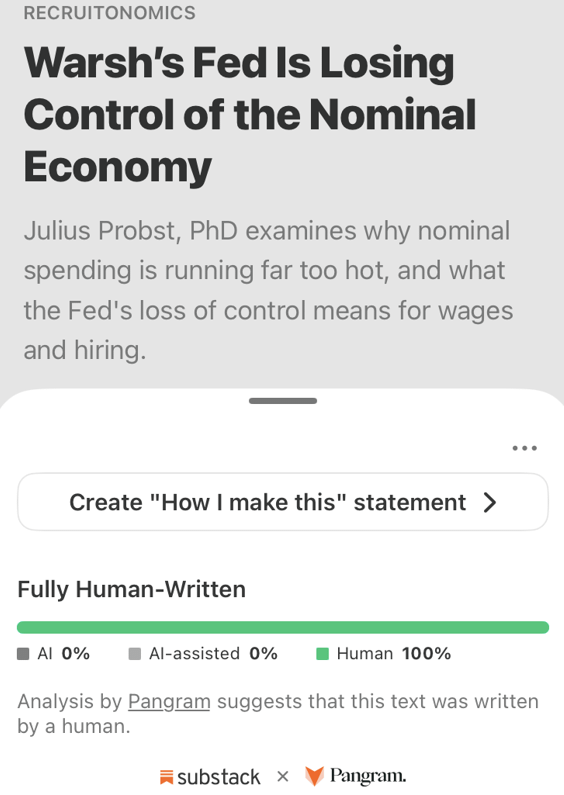
You might now object that Pangram’s verdict is a probabilistic estimate and therefore not bulletproof. But if we ever produce a piece where AI has played a substantial role in the writing process, our policy is to tell you upfront.
2. We use AI for editing
We use AI to edit our pieces. This includes typos, grammar, and language checks. We hope you appreciate that!
We also use AI for minor writing edits — this could involve shortening some sections that include repetition or some rephrasing of our own writing output, while keeping our tone of voice. The way we’ve used AI in editing so far is to ask it to identify places where our original phrasing wasn’t as crisp or clear as it could have been, and to suggest minor edits.
Sometimes we accept the AI edits, sometimes we don’t, sometimes we reprompt (and re-reprompt), and sometimes we use a mix of AI suggestions together with our own input to make further improvements. You get the idea. Generally speaking, we are quite conservative in our approach, which is precisely why every article of ours published since July 21 has been flagged as 100% human-written by Pangram.
3. We use AI for research
AI is extremely useful for research. Here are examples of how we might use it:
1. Providing a literature review; summarizing the state of the art on a given research topic
2. Fact-finding mission; providing us with data sources, prior analyses, etc.
3. Data analysis and creating charts (see below)
Where AI has played a supporting role, our policy is always to check the output for any mistakes it might make. Unlike others, Recruitonomics is not in the business of bringing you AI-hallucinated research output (I’m not going to mention names but you can read about some prominent examples in the papers).
4. We use AI for data analysis
This is the most obvious and exciting use case of AI, in our opinion. A lot of data analysis has become significantly faster with AI, which has helped us to write several research pieces that would have previously taken up too much of our time.
Here is an example: our recent analysis of German jobs with worker shortages. For some reason, the original data cannot be downloaded in one file but rather in three batches. We used Claude to translate all 519 professions from German into English. It also helped us to combine the data into a single file, to create the ranking for all jobs, and to run the correlation analysis between wage growth and the occupation shortage score. Doing all of this manually would have required hours of work from a research assistant.
5. We use AI for creating charts
Another obvious use case. While many of our charts are produced with Macrobond, AI has made it significantly easier to create Appcast-formatted charts using other data sources.
6. We *sometimes* use AI for idea generation
None of our articles have been thought up by AI — it plays a supporting role. We do use AI to bounce ideas around and bulletproof our own arguments and research, but the core ideas and data analysis are always generated by the Recruitonomics team. Rest assured, we are doing the hard thinking ourselves! And if this were ever not to be the case, our policy is to inform you upfront.
In this piece, we’ve spelled out the most important points of our AI policy because we believe you should know how we use AI in research and in writing. Our internal AI policy guideline is a longer, more detailed document than the overview we provided above. If you have any further questions or concerns about how the Recruitonomics team is using AI, do not hesitate to contact us: julius.probst@appcast.io