


Photo credit: Bill Mead
How will AI reshape our economies? What will the future hold for workers, and which occupations will continue to grow in the coming decade? Everybody is asking these questions right now, but nobody has the definitive answer. Researchers around the world are investigating AI’s impact on the labor market. For now, we don’t know for sure whether AI is destroying or creating jobs in aggregate.
In a previous piece, we used the occupational employment projections from the Bureau of Labor Statistics (BLS) to show that there is no correlation between high AI exposure and future employment growth. In other words, BLS researchers do not expect AI-exposed occupations to grow any faster — or slower — than the rest of the labor market. But what exactly are the occupations that will grow the fastest in the coming decade? In this piece, we will reveal the sectors and occupations that are projected to gain the most, and what that means for future job seekers.
It’s basically healthcare (and professional services)
Total employment between 2025 and 2035 is expected to grow by about 5.9 million, a mere 3.5%. That is significantly slower than in previous decades, and the reason is mainly demographics: lower immigration together with an aging workforce. The sectors driving most of the job growth are healthcare (+2.2 million), professional services (+930,000), accommodation and food services (+610,000), and construction (+410,000). While utilities and tech (information) are two of the fastest-growing sectors — +9.8% and +5.3%, respectively — they are a much smaller slice of total employment. Therefore, their total contribution to future job growth is less significant.
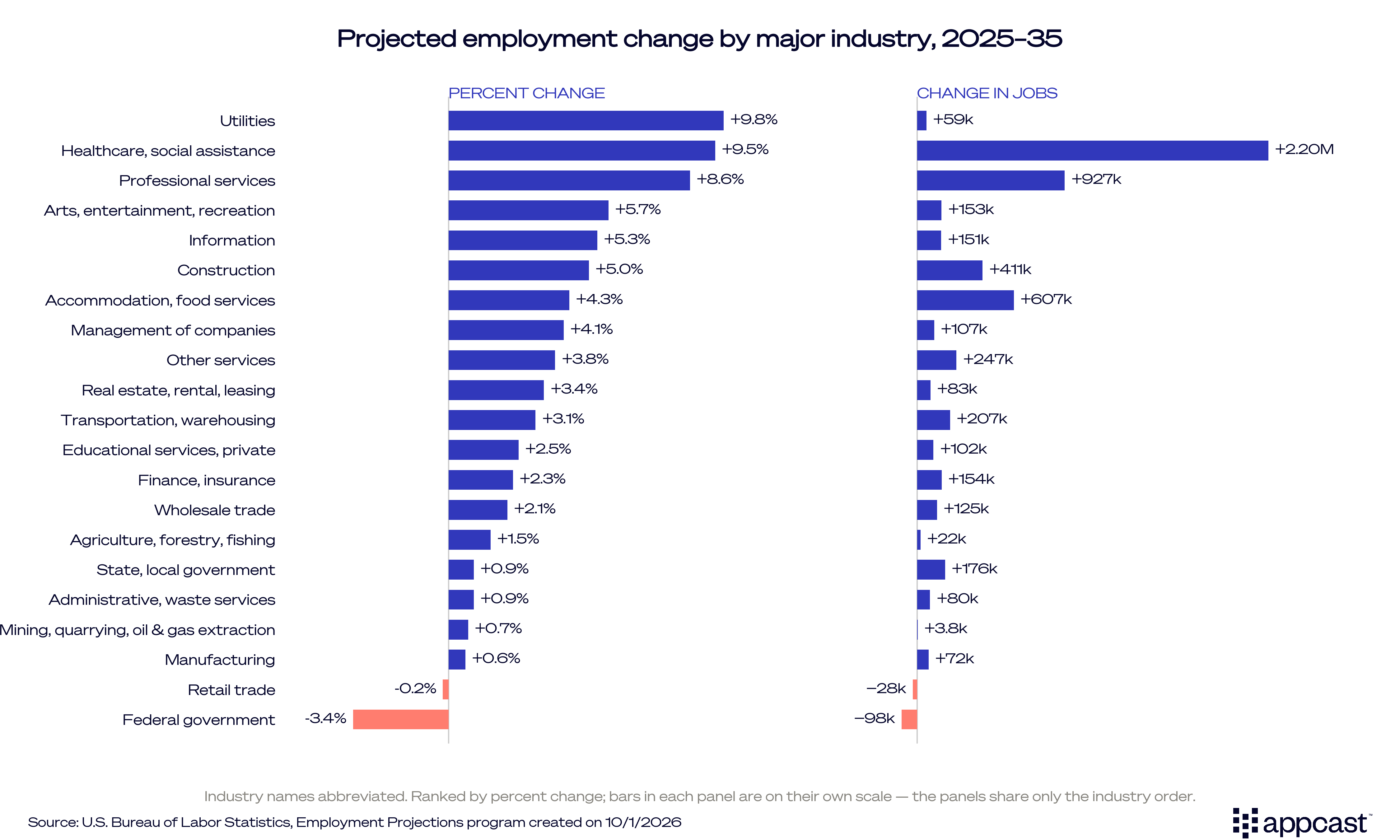
The fast growth in utilities makes sense. The current AI boom requires massive investment in power generation and grid infrastructure because new data centers consume vast amounts of energy. Furthermore, the push toward a greener economy means more investment in renewables. All of this points to expanding employment in the utility sector.
Healthcare needs are rising for two reasons: as people get richer and older, they will consume more healthcare services. And as the economy grows, construction and hospitality expand as well, especially since these are two sectors that have very little AI exposure: most jobs require a physical presence (think of waiters, baristas, and construction workers).
The anticipated employment boom in professional services and tech is one of the more interesting projections. For now, BLS researchers do not foresee any substantial job displacement coming from AI in those two sectors. Instead, they actually think that employment growth will outperform the national average quite handsomely (by a factor of almost two-and-a-half in the case of professional services). While there is no doubt that AI might lead to the shrinkage of some occupations, labor demand for the two sectors as a whole is expected to grow.
The future of jobs — nurses, therapists, solar installers, and data scientists
So, of the 831 distinct occupations that the BLS produces projections for, which jobs are expected to grow the most?
Nurses, therapists, epidemiologists, health counselors, care aides, medical technicians, and hearing aid specialists are among the highest-ranking healthcare roles. For professional services, we have data and computer scientists, computer and information systems managers, and information security analysts — apparently, the BLS shares our belief that cybercrime will become even more of an issue due to AI. Finally, fueled by the boom in renewables, two skilled trades also feature high on the list: solar photovoltaic installers and wind turbine service technicians, ranked second and fourth, respectively.
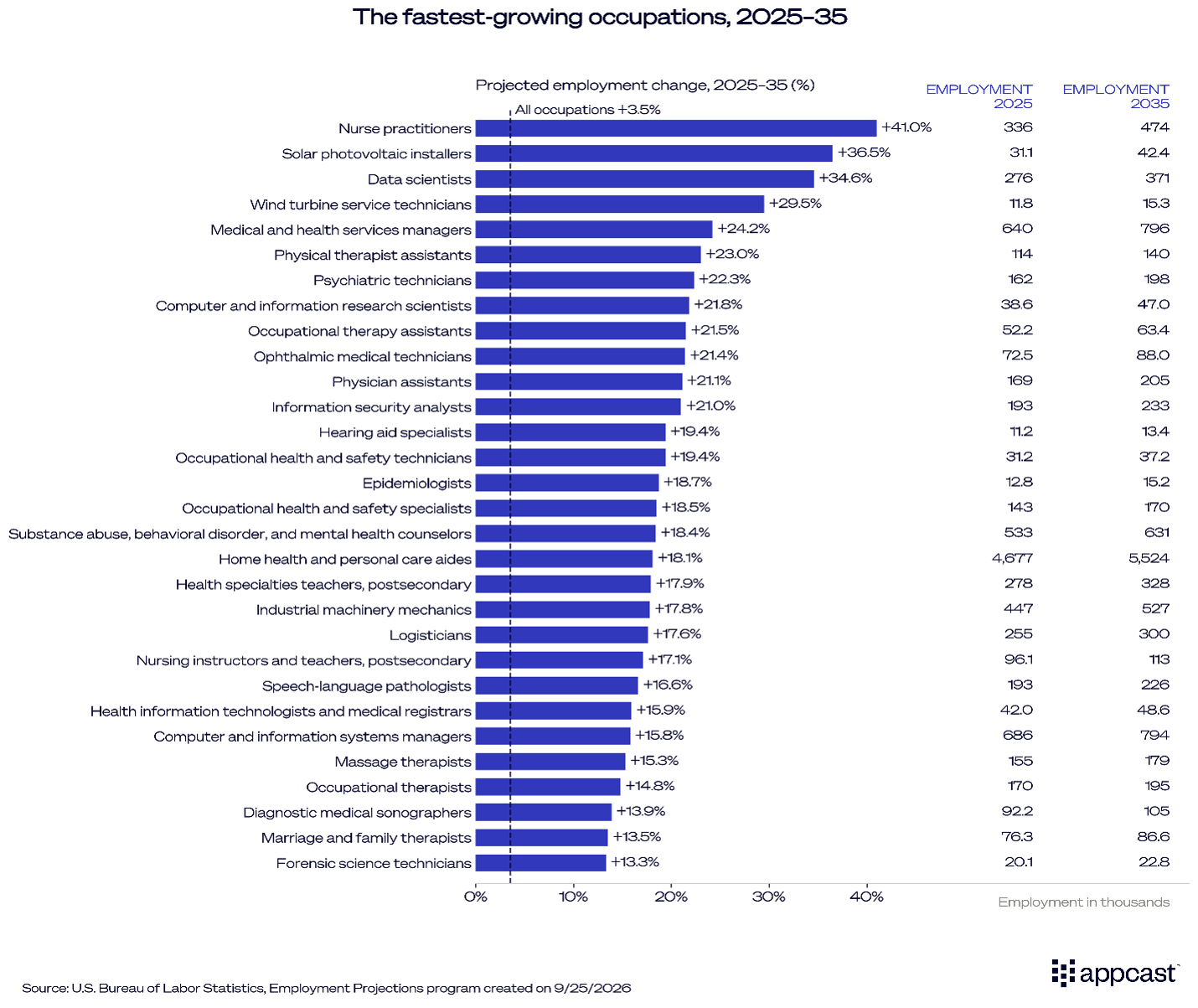
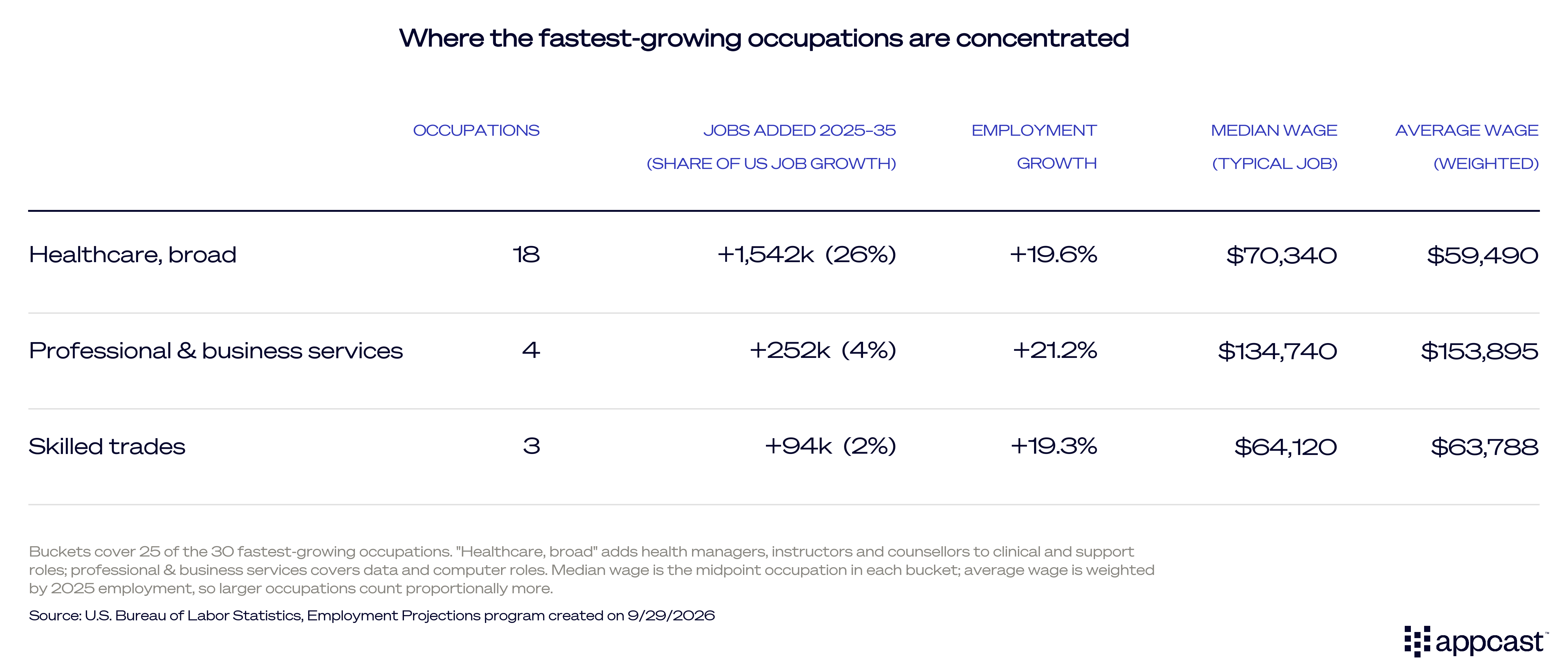
In case you didn’t count, 18 of the 30 fastest-growing occupations are in healthcare or healthcare-adjacent fields. They will also be the biggest source of employment growth, with care aides and nurses alone adding almost one million jobs over the coming decade. Only four occupations are in professional services, and three are in skilled trades. The 18 healthcare professions will grow by about 1.5 million jobs, while the four occupations in professional services will grow by only about 250,000. The three skilled trades occupations will add fewer than 100,000 jobs by 2035.
Among the fastest-growing occupations in the U.S., job growth is clearly divided along pay lines. The volume is in healthcare: These 18 occupations account for more than a quarter of all U.S. job growth, and care aides alone make up more than half of that. But care aides earn a median salary of just $36,000, by far the lowest-paying occupation, while the typical healthcare occupation on our list pays almost twice as much (about $70,000). The money is in tech: barely 250,000 additional jobs, but at an average pay of $154,000. Meanwhile, across the three skilled trade roles, pay runs at about $64,000. By comparison, the median annual wage for all U.S. workers is about $50,000.
The growth story: physical workers and AI jobs
The BLS employment projections show that the growth story runs along two distinct segments: physical workers and skilled AI workers. In fact, this is very much in line with what we speculated might happen as AI gets increasingly deployed in the economy. The physical sector consists of all jobs that require a physical presence. These are the healthcare, hospitality, and construction roles discussed above. As the economy grows thanks to AI, demand for these services goes up, and so does future job growth. Skilled AI workers are complementary to the technology and benefit from its rollout. Routine white-collar workers, on the other hand, make up the large segment that struggles as AI is deployed to automate tasks and displace workers. While this three-tier labor market is not the only future one can imagine, we believe that current trends are shaping up to produce this outcome. And the BLS forecasts appear to support this view.
What does this mean for recruiters?
We are currently witnessing the fastest pace of technological progress in decades, making future projections about occupational job growth more uncertain than before. Nevertheless, BLS forecasts have historically been a relatively good guide to where the labor market is headed, and they are consistent with our own views.
The fastest-growing jobs probably hold some surprises. With healthcare dominating the list, tomorrow’s labor market will look like today’s: recruiters will face persistent worker shortages and fierce competition for healthcare workers, putting upward pressure on pay. Skilled trades workers, especially those in renewables, might also be hard to come by as demand surges. The big surprise is probably professional services. Instead of AI displacing workers, skilled AI roles are projected to grow disproportionately. As the supply of talent fails to keep up, recruiters will struggle to fill some of these vacancies, while compensation climbs. The weakness will be in routine white-collar roles, where much of the work could be automated.