


Photo credit: Igor Omilaev
There is no doubt that AI has started to change the labor market — though sometimes in unexpected ways. So far, the bigger economic impact has come through the data center construction boom, which has mainly benefited skilled blue-collar workers. While AI’s effect on white-collar sectors has been more limited than many predicted, that might be about to change. Worker productivity in tech and in professional services is accelerating. The big questions that everybody is asking right now: What will happen to the jobs most exposed to AI? Will we see rapid worker displacement for certain occupations, and can AI create job opportunities elsewhere?
To answer these questions, we analyzed the occupational employment projections from the Bureau of Labor Statistics (BLS). As is often the case with technological change, AI’s impact on the economy is multifaceted. It will take years for the technology to significantly transform the labor market. The somewhat boring but hopefully reassuring finding is that the jobs with the highest AI exposure are not projected to grow any slower or faster than the rest.
How the BLS measures AI exposure
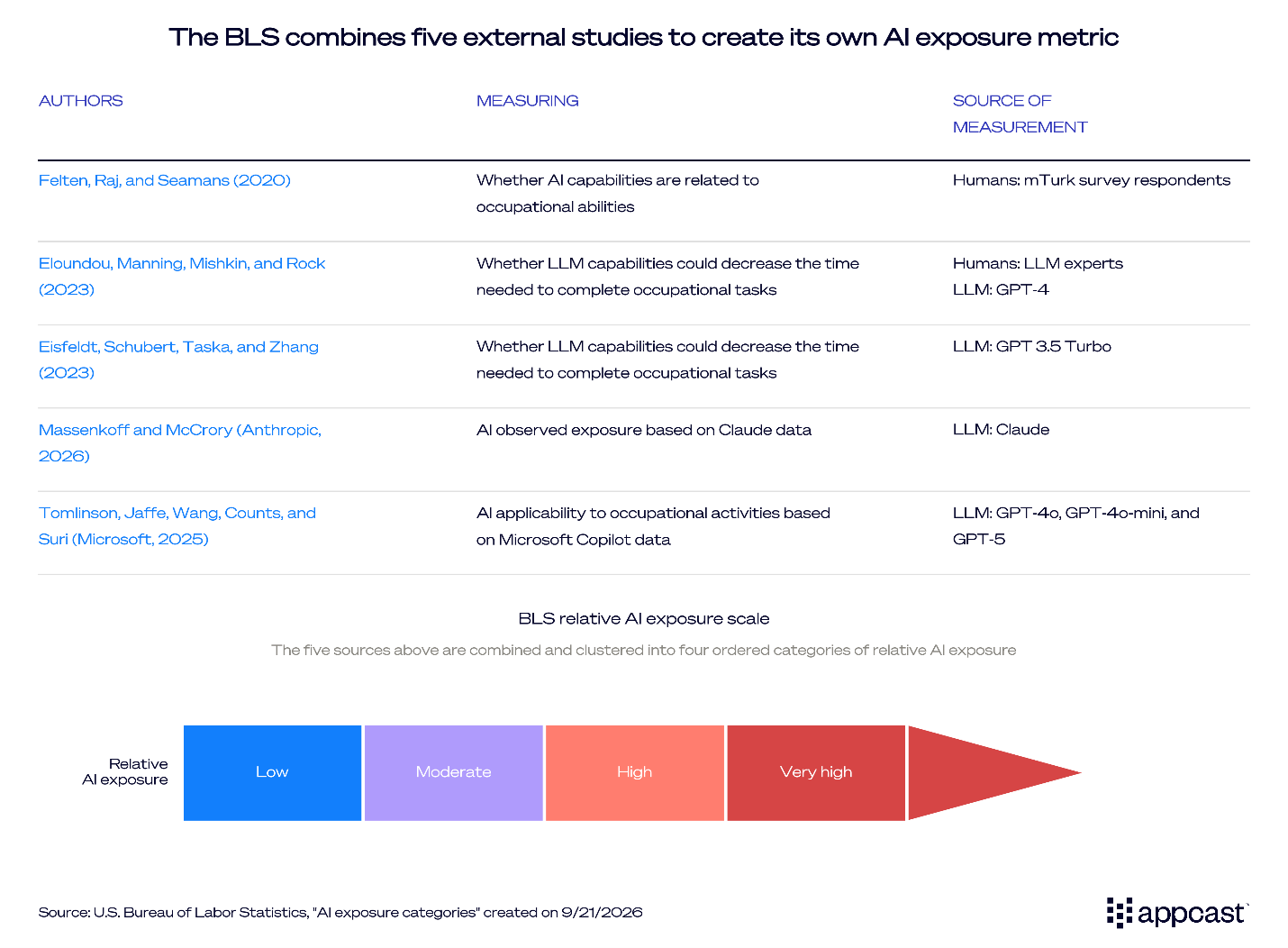
The BLS has published forecasts for occupational employment growth for decades. Its latest iteration is a projection from 2025 to 2035. For the first time, BLS researchers also produced a measure of AI exposure for every occupation. In general, one can distinguish between “theoretical exposure” and “observed exposure”: the former asks to what extent large language models can reduce the time spent on occupational tasks, while the latter measures actual AI usage within a certain occupation based on Claude or Copilot data.
Combining five sources, BLS researchers sorted 831 occupations into four AI exposure categories:
Low
Moderate
High
Very high
AI exposure is positively correlated with earnings
The typical occupation in the very high exposure category pays a median wage of around $78,000, a striking 60% higher than in the low exposure category. The difference shrinks slightly when using averages, but the overall pattern holds: occupations with higher AI exposure pay significantly better. This is not surprising. Well-paid white-collar roles in marketing, digital advertising, tech, and finance are the ones where many tasks can be automated by AI. These jobs also typically require a bachelor's degree or higher, and college education has historically commanded a strong wage premium, especially in the U.S. While there is some evidence that this premium is now shrinking, higher education is still closely linked to earnings, which helps explain the positive relationship between AI exposure and pay.
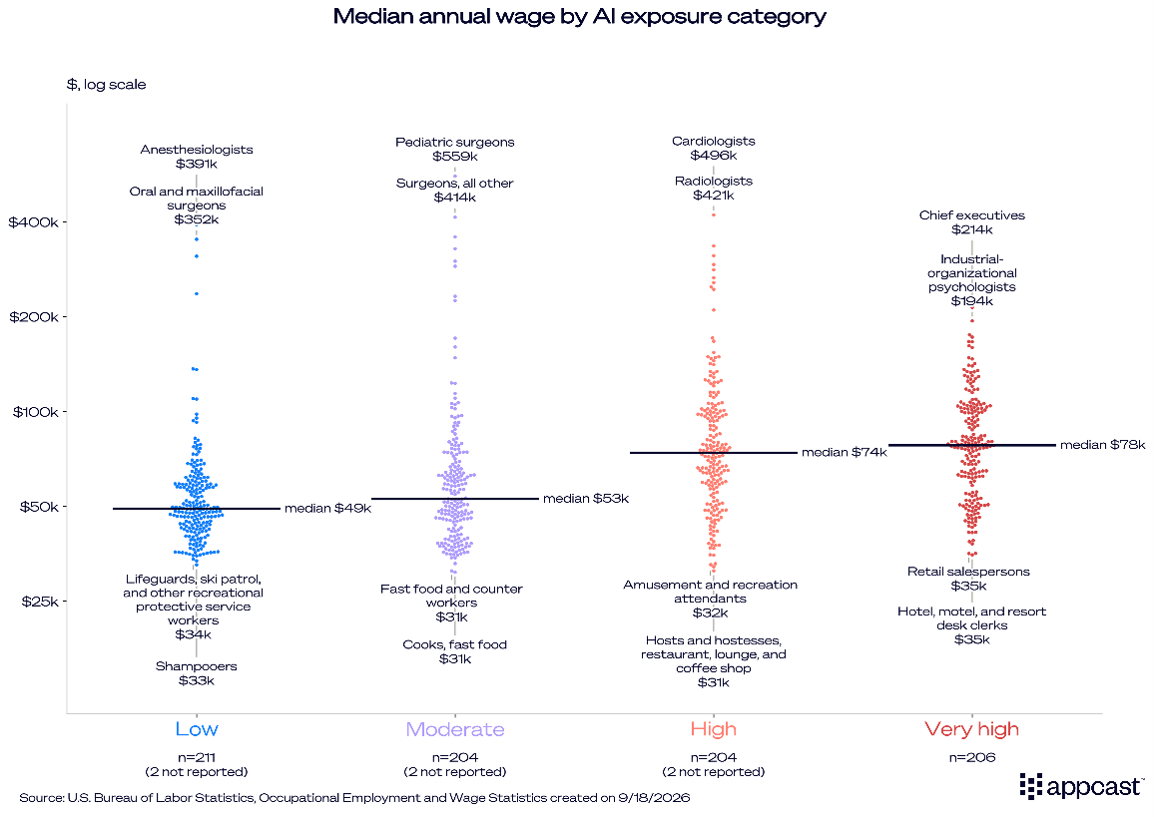
Healthcare is an outlier when it comes to AI exposure and pay. These roles typically require a physical presence — think of dentists and nurses. At the same time, lengthy education requirements restrict worker supply, while the demand for healthcare is only going up. As a result, healthcare jobs command a wage premium relative to many other occupations with low AI exposure.
Future employment growth is uncorrelated with AI exposure
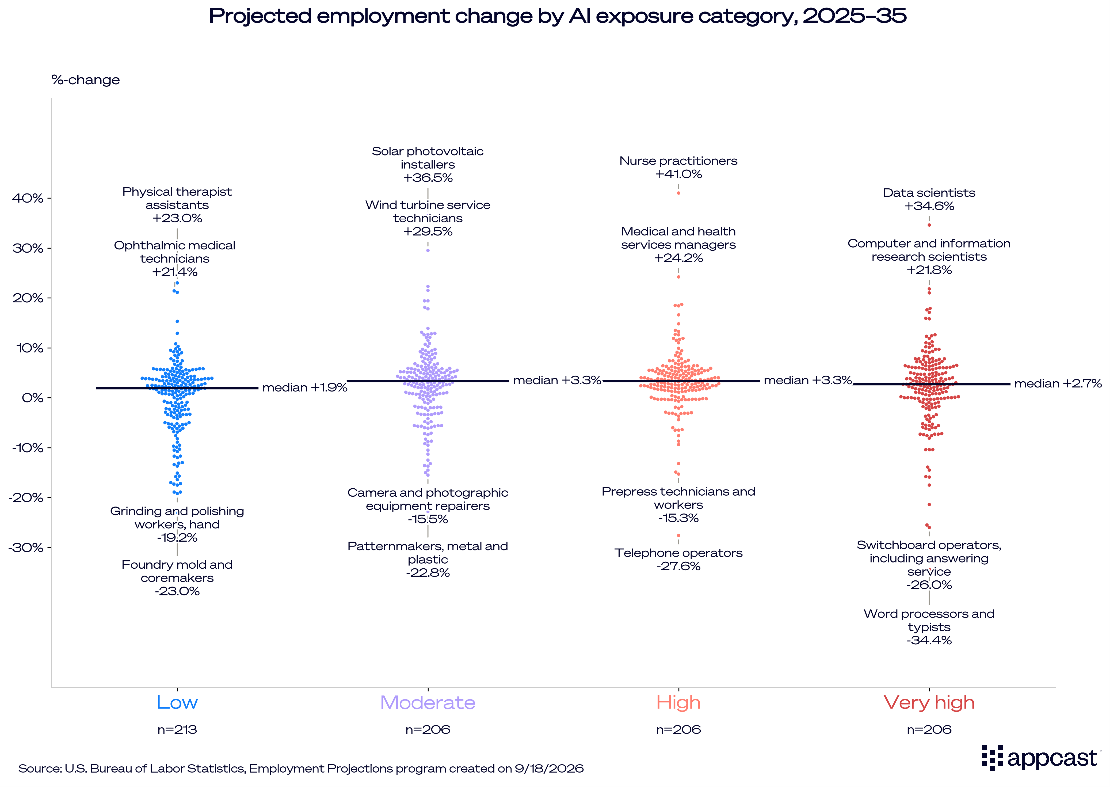
While wages are correlated with AI exposure, projected employment growth is not. Occupations with low AI exposure are expected to grow slightly slower than the rest. Moderate and high exposure jobs have the highest projected employment growth. Across 831 occupations, there is no relationship between a job’s AI exposure and whether it will grow or shrink.
The very high AI exposure category has several rapidly shrinking occupations (typists and switchboard operators) alongside others growing fast (data scientists). However, the dispersion within that category is no higher than elsewhere. Occupations at the low end of the exposure scale are just as likely to move sharply in one direction or the other — so whatever is pulling jobs apart in terms of future growth, AI exposure doesn’t seem to be the cause.
Well-paid jobs are expected to grow faster, especially those with very high AI exposure
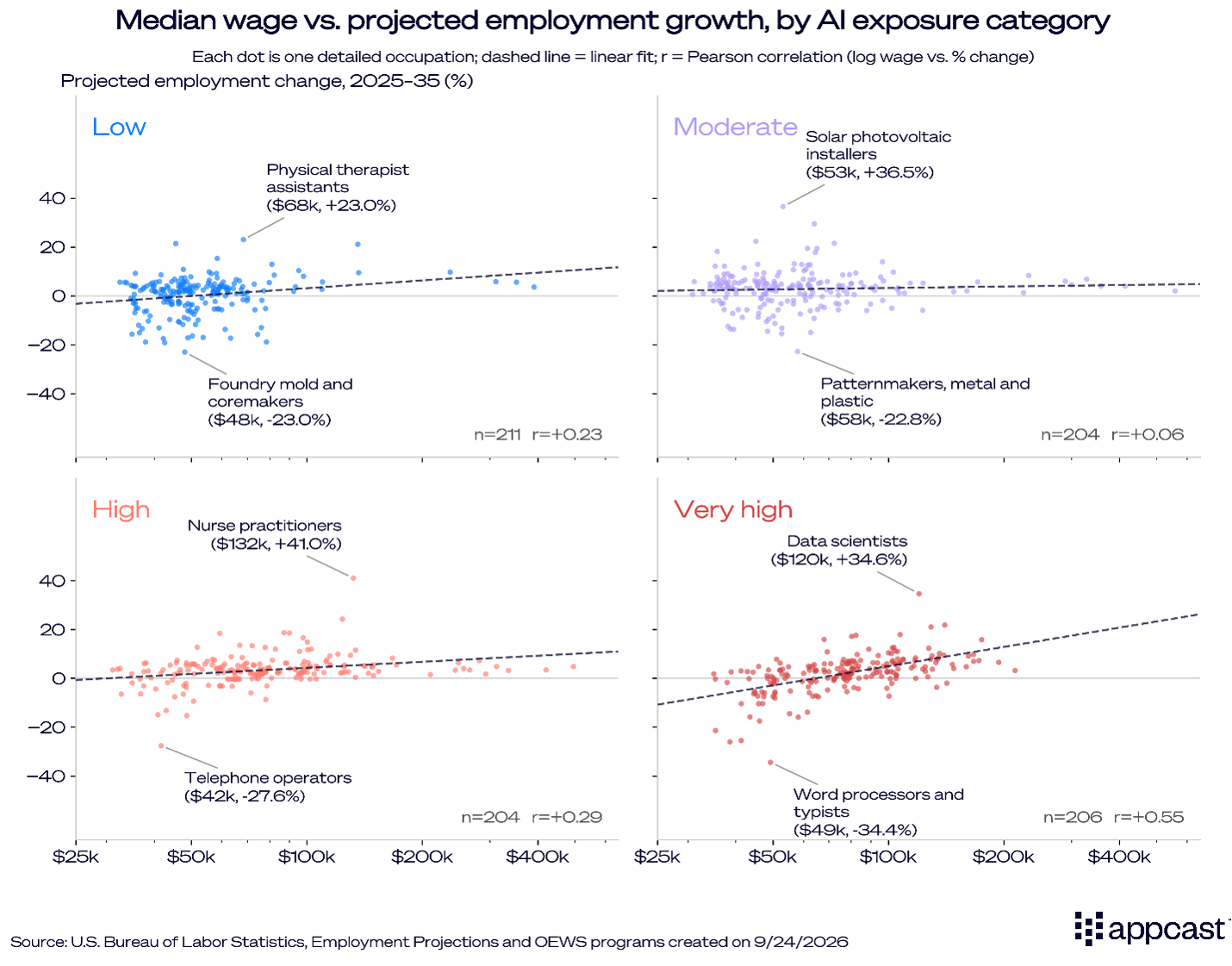
Our analysis also reveals a positive correlation between median salary and employment growth when we group occupations by AI exposure. Among the most AI-exposed occupations, projected employment growth rises more steeply with pay: Each doubling of the median wage is associated with roughly 8 percentage points of additional growth. The relationship is much weaker in the other exposure categories. Instead of being an equalizer, AI might thus exacerbate inequality, at least within white-collar sectors, since workers in well-paid occupations benefit most from expanding employment opportunities.
How good is the BLS at forecasting?
If its projections haven’t historically been accurate, our entire analysis above might be moot. Here is what the data shows: Previous rounds have held up reasonably well, narrowly outperforming simple benchmark models. For 2008-2018, the BLS correctly predicted whether an occupation would grow or shrink about 78% of the time. Earlier evaluations also measured the error for individual occupations: For 1996-2006, projected employment levels were off by roughly 15% on average. That might not sound particularly accurate, but forecasting ten years of change across hundreds of occupations is hard, and some misses can be large: Camera and photographic equipment repairers were expected to grow 24% and instead shrank 69%. The takeaway is that BLS projections are a solid guide to broader labor market trends but might be less reliable for the fate of any single occupation.
Why AI isn’t displacing jobs: It’s automating tasks
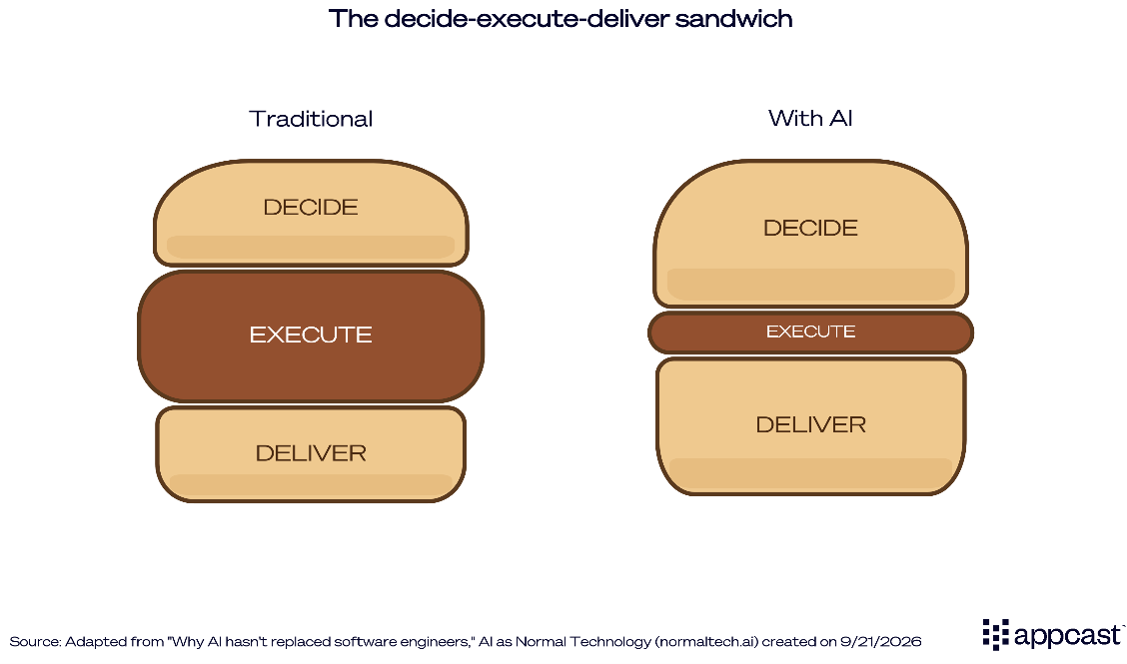
Software developers are a good example of how AI is changing tasks instead of displacing jobs. Defying some gloomy predictions, job postings for senior software developers have recently outperformed the market. AI can automate much of the coding, but coding itself was never the biggest bottleneck. Software developers now need to spend more time on oversight and decision-making as well as delivering work to stakeholders, whether customers or managers — all of which are more senior tasks. This helps explain both why the job hasn’t been automated and how it has changed to the detriment of junior workers, who haven’t yet acquired many of these skills.
What does this mean for recruiters?
It certainly looks like we’re on the cusp of a major technological transformation, but BLS researchers do not expect jobs with high AI exposure to grow any slower or faster than the rest through 2035. This is in line with other research, which remains mixed: While some studies have found that AI has started to displace workers in certain occupations, others have reached the opposite conclusion.
How AI will affect inequality is even harder to estimate. Large wage gains in blue-collar roles have reduced wage dispersion, but skilled AI workers are seeing their compensation soar, with AI companies rivaling investment banks on pay. The BLS also projects that among occupations with very high AI exposure, well-paid jobs will grow faster, so workers at the lower end of the pay spectrum might lose out.
For recruiters, this means AI exposure alone is a poor guide to where hiring demand is heading. As AI absorbs routine execution, employers will increasingly screen for judgment, oversight, and stakeholder skills, making it harder for junior candidates to get a foot in the door. Software development, where senior roles are thriving while junior workers struggle, is a case in point.