Here are all the pieces that we published in August. Keep reading for data releases coming up this month and other interesting labor market news, brought to your inbox by the Recruitonomics team.
What Can We Learn From Manchester’s Economic Success?

Julius Probst, PhD examines the source of Manchester's growth story: professional business services and housing construction rather than manufacturing nostalgia.
The 10 Biggest Winners and Losers From AI

We break down which countries, occupations, and skills win and lose the most as AI reshapes economies and labor markets worldwide.
Recruitonomics’ AI Policy: This Is How We Do It

A summary of how we at Recruitonomics use AI responsibly to produce research and written content you can trust.
UK: August 2026 — Great GDP Figures Offer Some Relief but Job Losses Keep Mounting

Julius Probst, PhD examines why UK GDP is beating expectations even as the labor market keeps losing jobs, vacancies dry up, and young workers struggle most.
Warsh’s Fed Is Losing Control of the Nominal Economy

Julius Probst, PhD examines why nominal spending is running far too hot, and what the Fed's loss of control means for wages and hiring.
Julius Probst
After Strong Spring, Job Market Has Summer Swoon

Andrew Flowers and Sam Kuhn break down a puzzling July jobs report, in which payroll employment fell for the first time since February even as the unemployment rate ticked down.
The 20 Hardest Jobs to Fill in Germany

Julius Probst, PhD ranks Germany's hardest-to-fill occupations and shows how worker shortages are driving up wages and hiring times, especially in trades and healthcare.
Upcoming Economic Data Releases and Events
· September 4: US Employment Situation Report
· September 7: Eurozone GDP (regular estimate, Q2 2026) and employment data
· September 11: US CPI
· September 11: UK GDP (monthly estimate, July 2026)
· September 15: UK Labour Market Overview
· September 15: Eurozone vacancy statistics (Q2 2026)
· September 16: UK CPI
· September 17: Eurozone CPI (final August reading)
In recent news:
Julius Probst, PhD
AI is reshaping labor markets in unexpected ways
While the most obvious aspect of the AI boom is software — chatbots, copilots, and agents — its largest economic footprint right now is physical. The technology built to automate knowledge work is, first and foremost, one of the biggest capital-investment programs in modern history. The numbers are hard to overstate. Just four companies (Amazon, Alphabet, Microsoft, and Meta) are on track to spend north of $700 billion on capital expenditure globally this year, roughly seven times their combined outlay five years ago.
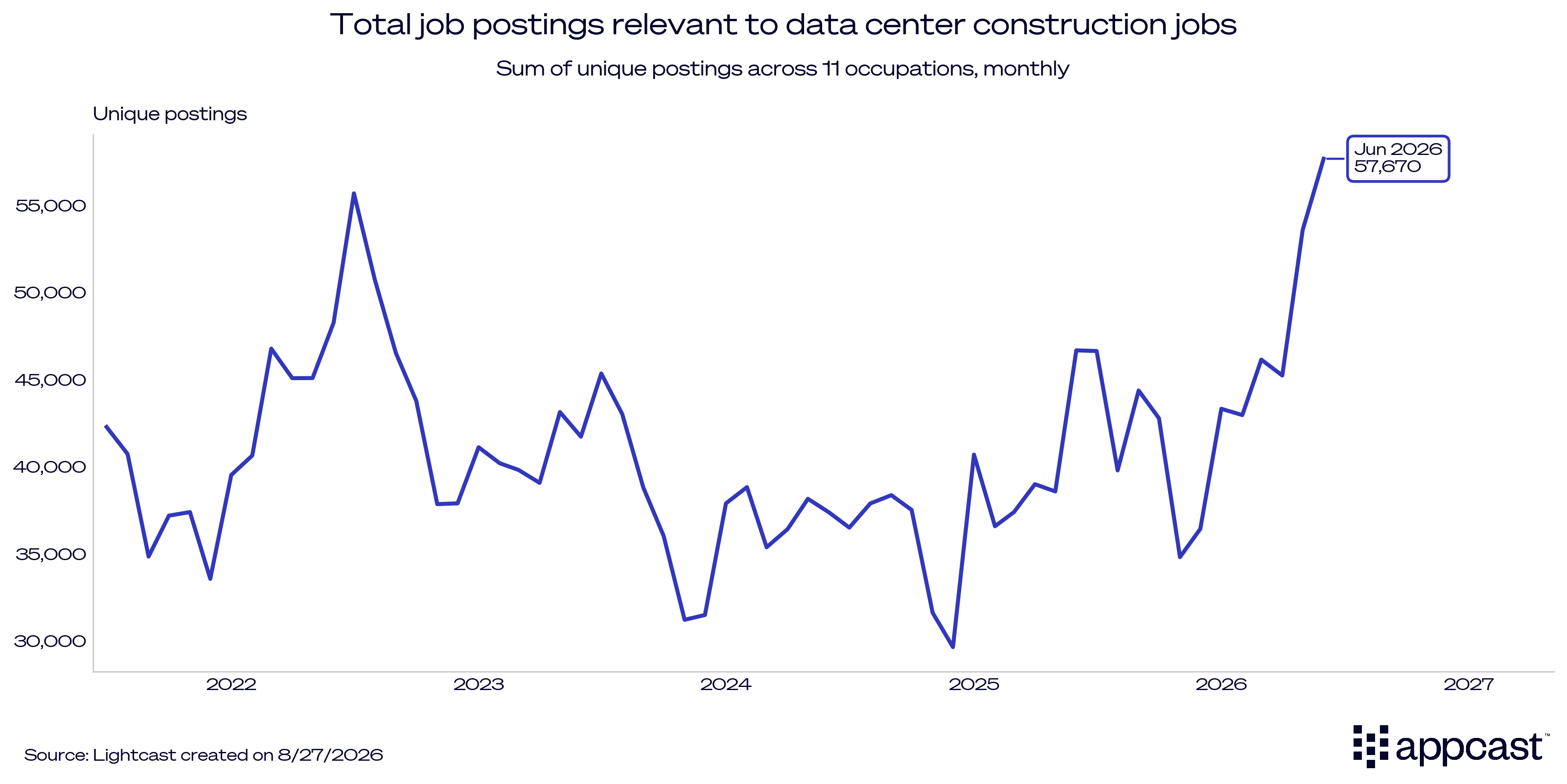
A large share of this money flows into the US economy. At 1.6% of GDP, AI-related capital spending has now surpassed the peak of the late-1990s telecom boom. The spending spree in the U.S. is also starting to show up in the labor market data, and the occupations benefiting the most aren’t the ones the AI narrative would predict. There is a significant surge in demand for construction workers, electricians, HVAC technicians, and pipefitters who build and power the facilities. Lightcast postings data across eleven construction and skilled-trade occupations shows a hiring wave that began in early 2025 and is still accelerating: Unique postings in those occupations climbed from roughly 40,700 in January 2025 to an all-time high of 57,670 in June 2026, a 42% jump.
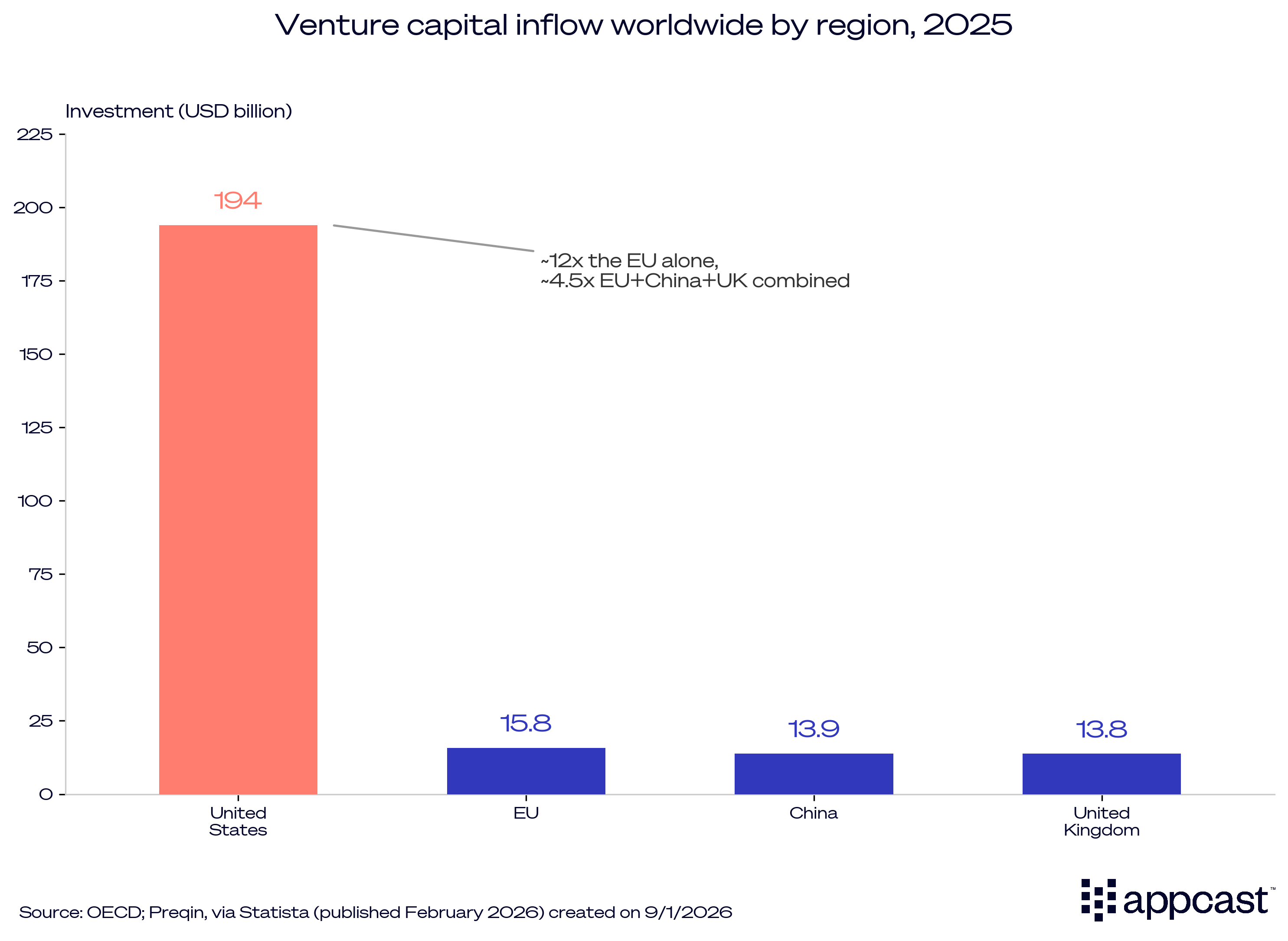
The imbalance in AI infrastructure spending is dwarfed by an even starker one in the private capital that funds AI companies in the first place. Venture money, unrelated to the infrastructure build-out mentioned above, is pouring into AI startups at an unprecedented rate. And again, America is leading. In 2025, the U.S. attracted $194 billion in AI venture capital, more than twelve times the EU’s $15.8 billion. The U.K., despite an economy roughly a sixth the size of the EU’s, matched the EU’s entire AI venture capital inflow almost dollar for dollar ($13.8 billion versus $15.8 billion). This is a striking illustration of how the Anglosphere is dominating the current technological supercycle. The AI business ecosystem is mainly being built in the U.S. — and, to a lesser extent, the U.K. — where startups and technology companies benefit from the deep financial networks of large American cities and London.
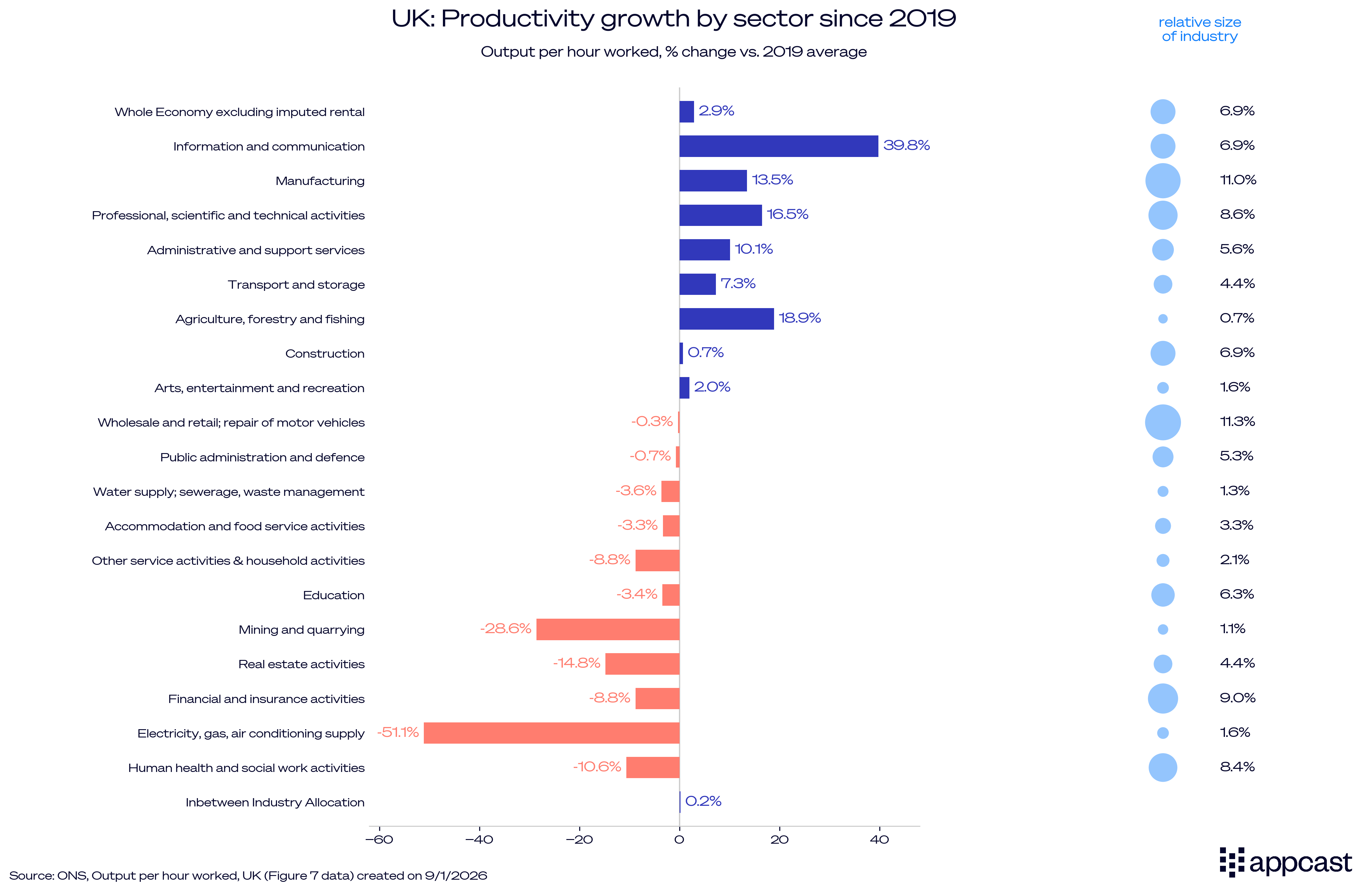
The obvious follow-up question is whether our economies will benefit from this surge in AI investment in the long run, or whether it’s just a lot of money poured down the drain. While it is a little too early to be certain, there are some tentative signs that AI is starting to increase worker productivity. The U.K. — long known for suffering from two decades of subpar economic growth — is experiencing a small productivity revival, according to some preliminary data. And it’s showing up in exactly the parts of the economy where we would expect artificial intelligence to have an impact: the tech sector and professional business services. Since 2019, output per hour worked has increased by 40% in tech and by 16.5% in professional business services (5.15% and 2.3% annualized growth, respectively). This has been sufficient to boost growth in the U.K. even as the economy faces several other headwinds (the oil price shock and elevated global uncertainty, among others). If these rates can be sustained thanks to faster AI adoption, living standards could finally start improving again. That would be welcome news, and further evidence that the AI investment boom is translating into real economic gains.